q

You are browsing the archive for Sales Training.

Selling Professional Services

June 14, 2013 in Attitudes & Behaviours, Business Acumen, Education in Sales, Sales Skills, Sales Training

This article first appeared on June 12, 2013 on BRW

Professional services providers face a challenge that many within the sector are struggling to come to terms with. For centuries the sector – comprising doctors, lawyers, accountants engineers and the like – enjoyed a somewhat exalted position in society.

Ignorance among the general populace, fuelled primarily by the high cost of education, made studying to be a doctor, lawyer or other profession out of the reach of most, and created an impression that being a professional made the individual somewhat special.

However today, wide, relatively easy access to education and the internet has reduced (if not entirely eliminated) the barriers. A wider general knowledge and more practitioners in each of these professions – all competing for a share of business that isn’t growing as fast as institutes are turning them out – is making it an imperative for professionals to find effective ways to generate business.

advertising brochure professional services

advertising brochure for professional services

Only a little more than a decade ago practitioners in these professions viewed advertising and marketing their services as being unprofessional and rather unethical. However time (and economic pressure) has forced their hand. They changed their opinion and started using brochures and advertising to generate new and additional business. Now the novelty of professionals advertising for business seems to have worn off. As advertising alone no longer generates the excitement for professional services that it once did, the more innovative in these professions have migrated to business development – a euphemism for selling.

The challenge for many professions faced with a decision to start more aggressive sales activities in their practices is two-fold. Firstly the image of salespeople is so badly misunderstood by professionals that they tend to shy away from even considering the notion of selling. Secondly, no course for accounts, lawyers, engineers or doctors teaches selling as part of the education of the people. As a result, most of these professionals either avoid selling or learn to “sell” from observation – often getting it totally wrong.

The key issue is how to deal with these two challenges.

Image problems

For starters, the image of salespeople as being opportunists or in some way unethical, even being charlatans who use high-pressure techniques and make any claim, simply to get a sale, refers to only a very few salespeople. As a comparison, not all lawyers are unethical professionals, even though some have been accused of simply chasing money or of less-than-professional behaviour.

The reputation of a few lawyers who have crossed the line refers to just a minority of evidently less-than-professional lawyers, not the entire profession. The same could be said for the medical profession. There have been instances when doctors have been charged with malpractice.

That doesn’t mean that the entire medical profession is unethical. Similarly, when a bridge collapses or a building wall falls over, one doesn’t blame the entire profession of engineering. On the contrary, the vast majority of doctors, lawyers, engineers and other professionals are hard-working, diligent, caring and capable professionals. And the same applies to salespeople. The few that have given the profession a bad name, are just that – a very few.

With regards to learning how to sell, there are a number of reputable organisations which provide sales training. Some have taken their processes to a higher level. Barrett Consulting, for example, has a sales development programme that is offered through Swinburne University of Technology as a VET-accredited sales program providing a Certificate IV in Business Sales. That course covers all of the essential elements of professional selling.

Professional services selling, on the other hand, is somewhat unique in several key ways.

1. Professional services are generally purchased based more on the personal and professional reputation of the individual partners in a practice, than the services provided by the practice as a whole. Why? Simply because most professions are regulated and as such, the services provided are controlled by law and by the profession’s own statutes and standards authorities. This restricted focus for professionals tends to temper the differences between professional service providers.

2. Most professionals are in a situation where they are expert advisers – often mixing their business development activities with advice that is also governed by statutes and regulations. As such, professionals need to be more sensitive to the accuracy of their claims and sales arguments. And while this may seem an inhibitor, in reality it is an advantage that makes the professional that much more credible.

3. And finally, professionals have to balance the way they generate business without being seen to be too aggressive in promoting the services of their firm or themselves.

askThere are a variety of skills and knowledge that professional services business development managers require, but there are only five guiding principles that underpin all of them …

  • Recognise that professionals can never be passionate about selling until they start searching for clients who they can be passionate about serving. Remember, too, that a great client is one for whom a professional would be prepared to work for free of charge, but who would never ask the professional to do so.
  • The best way to get new clients is to impress old ones. Measure the happiness of existing clients with the same kind of diligence used to measure time. That way professionals will focus on what makes a satisfied client, rather than simply a high-billing one.
  • When meeting a potential client, don’t sell competence – sell compassion. Clients can get competence from any professional. Compassion, however, makes one professional unique and different from another.
  • The single best way to get new clients is to ask current clients how to get more clients like them.
  • The best thing a professional service provider can promise a prospective client is more sleep. Ask what problems keep clients awake at night and build the practice around solving them.

Remember, everybody lives by selling something.

Peter Finkelstein, www.barrett.com.au

On your marks… Get set… GO!

December 6, 2012 in Attitudes & Behaviours, Education in Sales, Life Skills, Sales Training, Self Development, Self Promotion, Success

A prosperous life after elite sport is critically important to elite athletes as many of them have dedicated the best part of their lives (some into their 30’s) pursing excellence in their chosen sport often leaving education or business pursuits on the side.  These elite athletes know that achieving excellence in sport requires dedication, determination, discipline and sacrifice.  So what do you do career wise after a life in elite sport?  Or what can you do business wise while still pursuing your sporting goals?

These are just two of the many questions asked by the ACE (Athlete Career & Education) advisors of the many Victorian Institute of Sport (VIS) athletes when looking for this year’s participants in the third VIS Barrett Business Scholarship program.

victorian institute of sports logoFor the last 2-3 months I have been working with 11 elite athletes from the VIS helping them develop their business ideas and actual businesses via the VIS Barrett Business Scholarship program.  And this week three of the athletes stepped up and presented their vision and Go-to-market action plans to a panel looking to win a business/sales coaching scholarship with Barrett in 2013.

The process has been amazing for all concerned with some incredible insights, ideas and initiatives now in progress and of course, there was a winner.

What was fantastic about the 2012 program is we had athletes from many sports including able-bodied and paralympic athletes: wheel chair rugby, track & field, golf, cycling, rowing, canoeing slalom, snowboarding and equestrian/para-triathlon; we had Olympic and Paralympic medalists and an athlete who had just returned from their third Olympics campaign looking at their 4th in 2016 at Rio.  

What was even more amazing was the range of businesses that were represented on the program, each very different and each requiring a considered approach about how they need to get to market and position themselves effectively to win the hearts and minds of their customers and markets.  

Using the Sales Essentials Models, philosophy and principles coupled with brain science we worked together developing viable Go-to-market action plans for each of their businesses or business ideas.  The collective learning shared across the group really accelerated the understanding of how businesses can differ in how they need to go to market.   While there are common elements to be applied in all aspects of a functioning business and especially in sales, the real learning came when the athletes realised how they needed to fine tune Go-to-market action plans to hit the spot and get traction.  For instance when we looked at prospecting and developing new business each participant  needed to consider how they would prospect for new opportunities and get new clients on board.  By comparing and contrasting businesses we were able to see the weighting in direct calls to individuals or a weighting to social media campaigns needed in each case and there were distinct differences.

Alli van Ommen

Alli van Ommen (Victorian Tigers vs Drummoyne Devils)

Like the action and results oriented people they are, after each session these athletes would go out and apply what they learnt and examined, bringing back real life examples of the applications of their  efforts to the group.   Each session they continued to build on solid foundations.  What helped is that we created a  peer to peer learning environment which is a fantastic way to accelerate learning. With four sessions run over 2 months the athletes were able to gain entire group experiences ‘positive interdependence’, face-to-face interaction, group processing and individual and group accountability while working on their own businesses.   We consciously orchestrated each learning exercise which allowed the participants to fully engage in peer learning and reap the benefits.

What I love about this program is the opportunity to work with high performance individuals and see the ease with which they can transfer their knowledge and experience about being an elite athlete into the business arena.  Open to learning and not frightened to be challenged, here are some of the athletes’ insights from the program:

  • I never thought I was in selling and then realised that indeed I am in sales every day. If I do not make those calls then nothing changes and I get nowhere fast. However if I make the calls and the answer is ‘No’ at least I know.  But to my pleasant surprise there are so many Yes out there I just keep calling and guess what, there is business out there.
  • I realised that I had to pay as much attention to the prospect pipeline as I did to the customers we had got on board, if I didn’t we would have no business next season.
  • Getting the value proposition right and making it resonate with customers was crucial.  It is so important to see the world from your customers’ eyes.
  • I never knew really listening to someone was so hard – but when you do it’s really worth it.  Those listening and questioning exercises are vital.   
Steph Hickey, Cameron McKenzie-McHarg, Warwick Draper

Steph Hickey, Cameron McKenzie-McHarg, Warwick Draper(top to bottom)

Not all the athletes chose to go to final presentation evening; some were still working their way through the formation of their business ideas.  But those who presented did an excellent job. The panel was extremely impressed and it was a tough decision to choose the winner.

Our finalists were:

Warwick Draper was the eventual winner after a tight race to the finish line, so watch this space.  If you want to know more about Warwick hear him speak about his preparation for the London Olympics. 

And if you are interested in how past participants and winners of the VIS Barrett Business Scholarship program are doing you can listen to and watch them via the youtube links below. 

Alli Van Ommen (sport – water polo; business – osteopathy)

Shane Reese & Luke Harper (sport – swimming and life saving; business – swim school)

Matt Berriman (sport – cricket; business digital media, general manager, business leader)

Don Elgin (sport – paralympic bronze medalist 2000 Sydney, athletics, business – speakers bureau)

Again it has been a privilege to watch new businesses come to life and work with such an amazing group of people.


Remember everybody lives by selling something.

Author: Sue Barrett, www.barrett.com.au 

Hot bath turned cold – ditch the Rah Rah

November 8, 2012 in Attitudes & Behaviours, Coaching, Education in Sales, Sales Coaching, Sales Culture, Sales Results, Sales Skills, Sales Training

Have you ever heard the expression “Hot bath turned cold’? Perhaps not, however if you have been involved in the sales training industry or sales management it is a term that is synonymous with the quick, sheep dip, Rah Rah motivational sessions that business leaders and sales managers run for their sales people in the hope that they will sell more.   Sadly the opposite is true.  At the very best these ‘hot bath’ motivation techniques can provide entertainment value, however at worst they can do more harm than good.  We get a lot of salespeople saying they are sick of these types of approaches to sales training because they are left with little to show for it – they are given no real skills or tools they can use in the field. And like a hot bath whatever warmth you may have felt while in, it soon gets cold with your short, medium and long term expectations of sales success never met.

Yet many companies think that all sales people need is a bit of motivation to make them sell more so they get in a pumped up motivational speaker with a bit of sales experience to tell war stories and how you can be like them if you only do this or that.   Management’s attempts to cut corners and scrimp on effective sales training and coaching are cheating our sales people, our customers and our businesses.

continuous learning cycle

never stop learning, a little bit every day ....

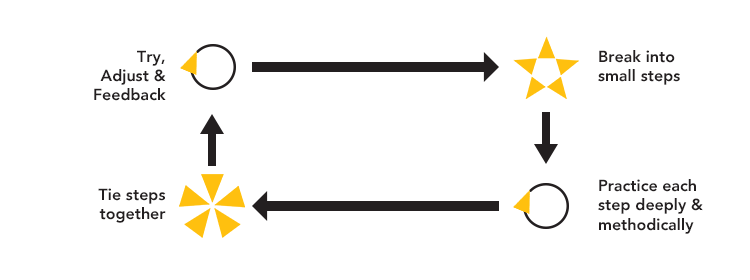
Well founded research in learning and development shows that continuous learning, a little bit every day, is the way to go. Smart, savvy, successful sales people need to train like athletes. This doesn’t mean spending a lot of money on fancy training– it means creating a culture of continuous learning where practice, reflection, self-learning and coaching occur daily using applied, practical sales tools and sales processes that can be easily transferred and taught.  That is why sales training and development programs like Barrett’s Sales Essentials are delivered over 20-40 weeks in bite size chunks to enable learning and development to take place and sales mastery to be achieved which in turn produces sales results.

Sales Training needs to be an integrated process involving role clarity, clear sales competencies, sales plans, sales metrics, regular infield coaching, etc. all linked to a strategy – not some afterthought or isolated event.

Ask yourself these questions:

Q. What are you trying to change by offering sales training?

Q. Do you want change to occur as a result of the training? if so, can it be defined and measured?

Q. What is the point of doing the training?

Q. What am I trying to achieve with training?

A study conducted a number of years ago found that within one week of leaving any sales skills training program (with no follow up sessions or coaching) salespeople had lost 87% of the new skills they had learned during the training program.  Recent research by ES Research Group shows that 90% of all sales training programs result in a 90 – 120 day increase in productivity – but after that, nothing. It was only a temporary blip! Fewer than 20% of companies show sustainable productivity gains that last a year or more.

What we have found, and learning research shows, is that sales training only works if it is carefully matched to and directly supporting the use of your sales model, methodology & sales force profile and it has to be supported by Coaching in the field and real world application hence the 70:20:10 learning philosophy made known by Morgan McCall, Robert W. Eichinger, and Michael M. Lombardo.

To ensure that real learning takes place and endures, we need to emphasise and encourage a holistic approach by integrating both formal and informal elements. The most effective way to learn and develop a new skill or behaviour is to apply and practice it on the job and in real life situations. Good learning and development philosophy is built upon how individuals internalise and apply what they learn based on how they acquire the knowledge.

70-20-10-Learning-PhilosophyThe 70:20:10 formula* that describes how learning occurs:

  • 70% from real life and on-the-job experiences, tasks and problem solving. This is the most important aspect of any learning and development plan. Many organizations agree in theory, but getting it right is another matter altogether.
  • 20% from feedback and from observing and working with role models – coaching from peers, subject matter experts and mentors.
  • 10% from formal training/learning so that participants gain a solid base of knowledge and skills.

At Barrett we believe that the key elements to a successful learning process include both the “70:20:10 formula” and how individuals internalise and apply what they’ve learned.

Effective sales training can be defined as a planned program within the organisation that endeavours to bring about relatively permanent changes in employee knowledge, skills, attitudes, and behaviours. Behaviour modelling training has been found to be most effective.

To give a long term benefit, the training needs to give your sales staff the opportunity to apply what they learn in real life situations out in the field and have regular reviews as to effectiveness and efficiency of application.

Leading companies will link this to a clearly communicated and committed sales capability plan and make it a conscious part of everything: every sales meeting, every sales call, every coaching encounter  will be about sales fitness.

So forget these RAH RAH Hot Bath sessions that promise the world and deliver nothing. You know they DON’T work! Now towel on down and get selling.

Remember everybody lives by selling something.
Author: Sue Barrett, www.barrett.com.au 

Why Sales doesn’t have its rightful place at the boardroom table?

August 17, 2012 in Education in Sales, Sales Culture, Sales Driven Organisations, Sales Excellence Acadamy, Sales Leadership, Sales Management, Sales Pioneer, Sales Training, Self Development

The 8th August 2012 was a milestone for Professional Salespeople around Australia: until that day there had been no officially recognised benchmark for professional selling at tertiary level. Whereas Finance, Marketing, Production, Engineering, IT, Business Administration, Research & Design, Human Resources, Logistics, Procurement and even Entrepreneurship all have recognized tertiary qualifications, Professional Business Selling is the last role in the Value Chain to be officially recognised in this space. So here we are – It has taken over 100 years for Selling to make it on the Australian Tertiary Curriculum.

Peter Finkelstein: Head Sales Strategy – Barrett Consulting Group gave a speech about Selling and its journey to legitimacy. Here is a summary of his speech at the Barrett – Swinburne University partnership launch to provide Australia’s first VET accredited, University endorsed sales training and development program, providing both a Diploma in Business and Certificate 4 in Business Sales.

Throughout my global travels I’ve noticed a universal truth – no-one aspires to becoming a salesperson..

every other career but sales

every other career but sales

When I asked 142 boys and girls in Year 12 what their career choice was for when they left school answers included doctors, pilots, architects and marketing but not Sales.

So we come to the question – why does sales enjoy so little respect in the business mix that even children fail to regard it as a career choice? Everyone knows that without an effective sales function companies will not generate the revenue needed to sustain their business. Why then, is Sales so disrespected by management, academics and management scientists and even by young adults on the verge of going into business?

In my experience there are four reasons that stand out. Firstly it was the history of selling started the rot. Then, in the 1960′s Sales was high-jacked by marketing. Then there’s the general lack of understanding of the salesperson’s role by management and lastly the state of denial that many salespeople live with.

The history of selling started it. We’ve all heard tales of the “Snake oil Salesmen” – salesmen who travelled from town to town selling off the back of a wagon with empty promises of salvation and remedies that would solve every ailment. Buyers’ impression of salespeople at that time, “Don’t trust them. They tell lies to get you to buy.”

As the market matured and customers built resistance, salespeople developed different hard sell techniques. Snake oil selling was replaced with Mood then Barrier and finally Formula Selling. All three techniques designed to trap and manipulate customers into buying.

In the 1960′s, when the concept of formula selling failed to deliver the expected results, management turned to marketing for advice. After all marketing professionals were educated, had some form of university degree and were thus better qualified to answer sales problems than sales managers who only had a lot of experience on their side.

Given the confidence (misplaced as it may have been) that management has in marketing, it is not surprising that marketing high jacked Sales. Suddenly the “experts” on the subject of all things related to Sales and selling were marketing professionals.

They developed sales campaigns, took over the interface with management and became the custodians of customer knowledge and experts on customer profiles, behaviour, habits and needs.

The reality is that marketing did such a great public relations job, management saw them as squirrels – cute, cuddly and non-threatening – as opposed to sales, who are viewed as rats – hard, threatening and pushy. Management seems to have forgotten that both squirrels and rats are rodents. Sales and marketing are two sides of the same coin – equal partners who need one another.

Few senior executives come up through the ranks of sales. Most are accountants, engineers, MBAs, etc. Perhaps it’s because management have been to university, whereas salespeople have generally not, to be top earning professionals, that this skewed view has evolved. Most boardrooms see expert opinions sought from Finance, HR and Marketing but when the challenge is a sales problem everyone has an expert opinion for the sales manager (who is seldom invited to the board meeting).

Perhaps it’s the behaviour of salespeople and their managers – after all most salespeople are extrovert, apparently insensitive to the feelings of others, always out of the office enjoying the great weather, having long lunches and early evening drinks. If they get all the perks the least they can do is be humble and deliver the high volumes of sales the company demands

“Many salespeople today neglect to place the word “sales” on their business cards.”

Lastly, too many salespeople live in a state of denial. Many salespeople today neglect to place the word “sales” on their business cards. They have little respect for themselves or their profession preferring titles such as account manager, pre-sales support executive and consultant.

The fact is salespeople are trained in what they do. They learn about their products and services; about their competitors and their products and services, about their market, customers’ and their business, about marketing and about relationship building; about production, distribution and financial issues. They learn to understand costs and margins – if not the use of models, then certainly the practical application of them. And in the process they learn some selling skills. If they don’t do that their chances of making it are almost null.

That’s right. Professional salespeople spend a lot more than five years studying. The nature of the craft is one that demands practical implementation, so they learn and study on the job. Like tradesmen, they serve an apprenticeship that takes them through the stages of development until they can stand alone, un-supervised. So yes, they may not have university degrees and may not have studied for three years on a trot, but they are well trained and just as competent as other executives.And now, if they and their companies invest in these same salespeople getting a Diploma in Business they can reduce the learning curve, shorten the sales development cycle and fast-track their return on investment.


Remember everybody lives by selling something.

Author: Sue Barrett, www.barrett.com.au

B2B Field sales force to halve

June 28, 2012 in Attitudes & Behaviours, Communication, Customer Service, Education in Sales, Sales Culture, Sales Driven Organisations, Sales Pioneer, Sales Tips, Sales Training

What will sales teams look like over the next 5-10 years? How will we sell to and service our clients? Will our businesses actually require field sales representatives as all?

With ‘Field Sales Force Numbers To Halve’ voted the sixth most important sales trend for 2012 from The 12 Sales Trends of 2012 by our readers, these are critical questions business and sales leaders need to ask themselves if they want to have an effective sales effort.

WHY? With access to so much information available and a plethora of Me2 products to choose from, buyers have grown more sophisticated and better informed as consumers, especially in the B2B (business to business) space. The savvy business person knows that many of those commodity purchases they have traditionally made face-to-face with a sales representative can now be made online or via a telephone sales service centres thus saving them valuable time and money.

mayor transition ...

mayor transition ...

With the growth in client sophistication and the commoditisation of products themselves we are seeing the beginning of a massive restructure of sales forces as clients go online, and ditch the ‘order taker’ who adds no value. Smart sales leaders know this sacred cow is not long for this world. Seeing no real return in transactional field sales teams, many companies are now looking at either a major restructuring of their sales effort or major re-education of their sales teams.

Some companies have already begun planning for a major transition into the blended world of online and personal selling. Looking at their offerings, their clients’ buying preferences and the total cost of sale, these sales leaders are having to make strategic business decisions about whether they:

  1. choose to be in transactional, low margin business where products act as commodities and clients can be serviced via online and call centres with no or some minimal field representation at major account level

    OR

  2. choose to be in complex offering and invest in field sales forces that add real value to clients beyond the product itself and work in partnership educating clients on how to run a better business and achieve better results as the value moves from product to the value of intellectual property and ideas.

If businesses choose field force representation, the changes required in field sales force capability are monumental as we now require sales people to evolve into business people who can sell. Field sales forces will only remain relevant by working in the complex, unique solution space where their business acumen combined with a range of professional capabilities such teacher & facilitator, consultant, problem solver & preventer, financial manager, diplomat, and so on

transactional sales

transactional sales

will be of real value to their clients. Clients / buyers will only want to see and work with people who are willing to work in a collaborative manner with clear mandates and transparent practices. Trust will feature highly in these relationships as will continuous education and learning enabled by these more enriching and evolving relationships. This is where real relationships will be forged, based on substance and integrity and where a fair exchange of real value can flourish.

Those businesses who choose the transactional model need to make sure that they are easy to do business with; that purchases are uncomplicated; and when clients ask questions they should get answers easily – no run-around, no fuss, streamline and efficient.

As we transition into a more complex world the decisions we make about the business of our business will affect, positively or negatively, our future relevance and success. Choose wisely because the middle ground is fast disappearing.

Remember everybody lives by selling something.
Author: Sue Barrett, www.barrett.com.au

We have some very exciting news coming soon! In the mean time, it would be great if you could help us by completing this 5 minutes survey. Should sales be studied at degree level at University? Thank you!

Switch to our mobile site