
q

You are browsing the archive for Sales Driven Organisations.

Is your business Customer Focused & Customer Centric?

May 31, 2013 in Attitudes & Behaviours, Brand & Reputation, Education in Sales, Sales Culture, Sales Driven Organisations

As with many things these days, words or expressions get bandied about with little regard for what they really mean.  For instance, when we ask people how they define ‘Prospecting’, the overwhelming response is ‘Cold Calling’. Prospecting is far more than cold calling: it can happen anywhere with new, existing or lapsed accounts – anywhere you are trying to uncover and develop new business opportunities.  And with social networks abounding, very few people ever have to make a true cold call.  See what I mean?

And so we enter the confusing world of whether a company is Customer Focused or Customer Centric.  What do these terms mean anyway? Does it really matter which one we are?

Well, yes it does – quite significantly as it turns out.

What we at Barrett have observed is that few company executives appear to understand the difference between being customer-focused and customer-centric.

Customer Focused
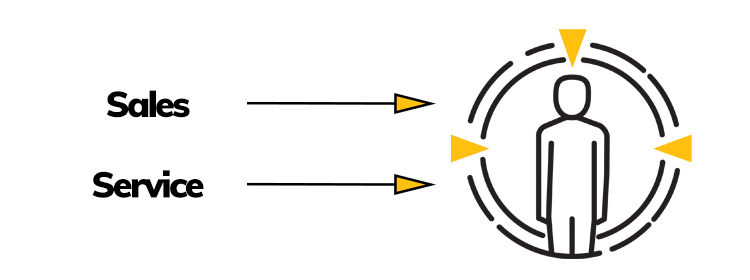
Me

Customer Centric


The Client


Customer-focused organisations generally structure sales so that they can maximise their return. That is, they look at how they can get more business from their customers by delivering a level of service that is slightly better than their rivals, and sometimes – though not always – offering a lower price. This often means that salespeople are trained to uncover buyer needs and offer solutions that address those needs. In short, customer-focused organisations address customer needs only in so far as these are self-serving and address the organisation’s goals and imperatives.

Customer-centric organisations, on the other hand, explore ways to satisfy the needs of their customers at the same time as delivering greater value, making it easier and a more delightful experience for their customers to buy from them – considering incremental sales only as a result of the degree to which customers have been satisfied.  Customer-centric organisations do this in the unequivocal belief that by demonstrating superior Customer-Centric behaviour, by investing heavily in making the customer’s experience unique and pleasurable, they will get increased support (and profits) from an expanding, loyal, customer base.  This means they also invest in their people to enable and empower every member of the customer centric organisation to make decisions on the spot to address client’s issues, needs, etc. Their company stories are centred around the customers success and how their founders and employees helped their customers succeed. By placing their people at the centre of their business, customer centric organisations coach and support their people to be and do their best so the business and its customers thrive.

This all sounds lovely but is being Customer Centric better for business?

Yes Absolutely!

The following companies are example of those organisations that are doing very well – consistently – across a number of dimensions including: customer loyalty, revenue, profitability, staff retention, leadership, etc. by being Customer Centric

  1. Nordstroms (USA up market retailer much like David Jones in concept)
  2. SAS (Scandinavian Air Services)
  3. Ritz Carlton


nordstrom_p1030099

With respect to Nordstroms, when asked at a recent investor meeting to quantify what the Customer-Centric approach had cost the organisation, the chairman’s response typified the philosophy and also demonstrates the difference between Customer-Focus and Customer-Centric behaviour.   John Nordstom (the chairman) responded by telling investors that the cost to the company was far less than the profits it had made from customers returning time and time again to buy apparel at their premium priced stores.

Locally, companies like Bunnings are also moving in this direction by hiring knowledgeable staff i.e. retired tradies, husband and wife teams; people who have real experience in home maintenance, gardening, building, etc.  who are empowered, proactive and interested in helping their customers.  We had  such an experience on the weekend with a Bunnings team member, who it turns out, makes guitars as well, who helped our son prepare to make a skate board using his knowledge of woodwork.  The other staff we interacted with were equally happy and helpful. It was impressive.

Contrast this with Customer-Focused behaviour…

In November 2012 the respected consumer advocacy group Choice published a report on the levels of service and Customer-Centric behaviours amongst Australia’s leading retailers.

Furniture and white goods giant Harvey Norman was found to deliver the very worst levels of service. However, when approached for comment, chairman Gerry Harvey said the consumer group Choice got it wrong, had a private agenda and that Harvey Norman’s service was fantastic.

7701Harvey Norman is undoubtedly Customer-Focused.  It tries hard to stock its stores with a range of products priced at an attractive level. It has staff roaming the floor who give the appearance of being interested in helping their customers. It spends huge sums on television advertising, trying to convince hard pressed customers to visit their stores for a great product, great prices and service. But someone has missed the plot. Either Choice has totally misread the realities or Harvey Norman has lost touch with its customers.

Is the Harvey Norman response, as opposed to the Nordstroms response typical of the difference between Customer-Focus and Customer-Centricity?  Well, let’s look at the results:

  •   Harvey Norman’s results for 2012 were 39.2% down on the previous year
  •   Nordstrom’s results showed  13.5% improvement, 2012 over 2011

So you be the judge.

In short, Customer-focused companies do some things that superficially address customer expectations, driven by their desire for improved profit performance.  Customer-centric organisations make meaningful changes in order to address their customer’s expectations, expecting and getting reciprocal support.

After all it was the late Peter Drucker – the great management guru of the 20th Century – who said: “The purpose of business is to satisfy its customers’ needs. The consequence of satisfying customers is improved, continuous profits…”

And you know it when you enter a customer centric organisation because everyone you speak to in the organisation is focused on you; they are interested in what you have to say and want to help you get what you need, they are genuine in their support and everyone seems to have the same set of principles and values they operate from – there is consistency across the board.

Outcome: you are left feeling safe, valued and cared for.  And usually you want to come back for more and perhaps even tell your family and friends about what a wonderful experience you had.

You can watch an entire presentation on Customer Centricity given by Peter Finkelstein at the recent Swinburne University Business Forum function:

Remember everybody lives by selling something.

Author: Sue Barrett, www.barrett.com.au

Breaking the Chain of Ignorance – upping the pace of transformation

May 10, 2013 in Attitudes & Behaviours, Communication, Sales Driven Organisations, Success, Vision, Mission & Purpose

In December 2012, we published the 12 Sales Trends Report for 2013 and released a brief summary of each trend. This month we are focusing on the Sales Trend “Breaking the Chain of Ignorance – upping the pace of transformation”.

It is not enough to adapt to change, we need to keep ahead of the curve and continue to transform ourselves before the change arrives – opting to stay conservative will be a riskier strategy than taking risks to transform.  But the risks don’t need to come from the unknown.  The key to this transformation is right before our eyes – it’s in our organisation’s own value chain.  

However, you can’t harness the power of your value chain, your thinking, your people and your stories if your thinking lacks clarity, your people are stuck in the traditions of the past and your stories are boring. Most organisations struggle to explain what they do and how they do it in a way that is both easily understood and generates a curiosity to know more.failure-to-communicate If we cannot communicate our story to our employees, customers, suppliers and investors then they cannot tell others nor can they make informed decisions. As a result we have employees, customers, suppliers and investors who do not understand why we are different and how we can benefit them and others. 

Think about the common mission statement or vision. Supposedly the bedrock of an organisation, what we find instead is a foundation of sand. Visions are often too broad to be useful. It isn’t that the vision doesn’t mean anything so much as it could mean anything. Too much is left open to interpretation and the result is our people, unsure of performance expectations, start working at cross-purposes. There are similar issues with values statements. The values are either poorly defined and open to interpretation or they merely reflect what an organisation thinks people would like to see rather than the reality.

What does this mean to you, your people, your colleagues and your business?

1. Most business or corporate values statements are virtually indistinguishable from each other.

2. Actions are what count – not what’s on paper.

3. If there’s a disconnect between what you say is important and what your people do, you need to fix that right away. Rather than building a series of rules, build a series of examples. People learn from examples and role models – not from a list of words.

Instead of looking outside for some magic potion to transform your business, this sales trend will see businesses materialising and mapping their value chains, business-tools-to-help-transformationharnessing their stories of  WHY and HOW and making sure they engage everyone across the businesses ensuring they understand their part in the value chain

Smart companies are connecting the dots – the people dots.  This sales trend is all about alignment and engaging all the people in your business with your Purpose, your story, the business of your business, the way forward.  What you say you want, what you really want, and what you reward all have to be in alignment. If people are ignorant of what you stand for then it is time to break that chain of ignorance.   And then everybody will understand that selling is everybody’s business.

Remember everybody lives by selling something.

Author: Sue Barrett, www.barrett.com.au 

PS: Dr Peter Finkelstein, Barrett’s Head of Sales Strategy will be talking at Swinburne University of Technology on May 22 about Creating a Sales Operation that Delivers Optimal Value. You can register here 

How many clients and sales are you losing out the back door?

April 24, 2013 in Attitudes & Behaviours, Brand & Reputation, Customer Service, Sales Culture, Sales Driven Organisations

Are you aware that it is six (6) times more expensive to acquire a new client than it is to retain an existing client?

Keeping clients onboard and engaged with your business is just as important as your sales team finding new business sales with new and existing clients, however many businesses do not pay enough attention to the back end of their business leaving client retention to chance.

Have you ever mapped the whole value chain of your business and looked at where your clients engage with your company?

How many client touch points are there? 

The more client touch points there are across your business the more chances you have of either:

  • impressing your clients and keeping them engaged with your business due to great service, great solutions,  great ideas and due respect for your clients’ custom OR
  • losing them out the back door due to poor service, poor communications, non-user friendly systems and resources, difficult complaints handling procedures or just plain indifference on the part of  the client services team or other departments

customer-retentionToo many business leaders complain about poor sales results yet they don’t address a major sales issue – the retention of existing clients and repeat business.  For example, one Barrett client reported recently that their sales team brought in 4,500 new accounts in one year while their service/operational teams lost just over 4,000 accounts because of poor service and indifference to client priorities – ‘It’s not my job’ was the catch cry down the line.  Fed up and frustrated their clients just stopped doing business with that company and no one asked why… until recently and now the real reason for declining Sales Growth is emerging.  This company is not alone – losing good quality sales and clients due to disconnected or disengaged staff beyond the sales team is a real problem. 

So before you lay blame solely on your sales team for declining sales you may like to look at the following information: 

-          Over 68% of clients leave a business because they are upset with the treatment they have received from the people in that business.

-          However, between 54-70% of clients who complain will nevertheless continue to be clients if their complaint is resolved effectively and respectfully.

Prior to the internet one study revealed that happy clients, or clients who have their complaints satisfactorily resolved, told 3 to 5 people while one unhappy client told eleven people, who in turn told five other people.   Now clients can tell about their experiences with suppliers and service providers to hundreds and thousands of people in an instant using social media.  The exact numbers are not specific but with technologies like Twitter and FaceBook companies reputations and brands can be made or broken by client feedback almost instantly.

Clients have more options than ever before and if sales and service experiences are poor they will feel less loyalty as a result. Clients want products and services faster, cheaper and better from whoever will provide them. That means that as a sales and service provider, the competitive advantage for your company rests with you and your people across the entire value chain. 

Client loyalty develops as clients feel a connection with a company and its staff. After all, most companies have the same “stuff”; it’s the genuine understanding of someone’s needs and priorities, the effective delivery of products and services that meet and satisfy those needs, and the genuine offer of service that causes product and company differentiation.

Customer Loyalty is rewarded

Customer Loyalty is rewarded

Organisations that provide superior sales and service experiences can charge more, create greater profits and achieve greater market share, because clients will generally perceive more value and be willing to pay a premium for superior advice and service.

When companies have a commitment to sales and service across their entire value chain it raises the bar of competition. The only way companies can effectively accomplish this is through their employees. As the competitive bar goes up, the quality of employees must go up equally.

Having a better team is good for the individual employee, good for the company and very good for the client. When a company is committed to a proactive sales and service culture, its corporate culture will change to absorb this new dimension, first becoming an integral part, and then becoming the driving force causing amazing results to take place.

The subsequent culture is automatic and infectious. Employees will demand it of new employees, and the corporate culture becomes even stronger because employees have taken ownership.

If you want client loyalty and repeat sales you need to make sure that everyone in your business understands: That selling is everybody’s business and everybody lives by selling something. 

Remember everybody lives by selling something.

Author: Sue Barrett, www.barrett.com.au 

Are you paying salespeople enough to sell well?

February 14, 2013 in Attitudes & Behaviours, Brain Science, Complex Selling & Transactional Selling, Sales Driven Organisations, Sales Talent

Are you paying your salespeople enough to enable them to focus on selling and not worry about where their next paycheck is coming from?  Because if salespeople are constantly worrying about when they are going to get paid, how can they sell well?

For many years, unlike most other salaried employees who can rely on a regular weekly/monthly pay check, salespeople have often been required to live hand-to-mouth – making sales and waiting for their commission or bonus to supplement their living income.  Often the commission or bonus comes in monthly or quarterly bursts, however there is no guarantee of what money salespeople will make each month.  Worse, there can be arguments and struggles with companies as to what they should or could be paid. 

thinking about one thing only

thinking about one thing only

Earning a decent income for their efforts is never far from salespeople’s minds and if times are tough it is usually the only thing on their mind. Obviously this obsessive focus on income can lead to all sorts of issues, not all positive.

Imagine that you are a salesperson and in a good year earn anywhere from $80,000 to $130,000 per year gross.  Imagine too that you are also paid a low basic salary (let’s say around $40,000 a year) and the rest of your income comes from commissions or bonuses from selling.  Imagine too that your salary structure means your company recovers what it paid you as a basic salary out of the total amount you earn each year.  

Like all of us, you have living costs to account for such as mortgages, daily living expenses, family commitments etc..  Over time you develop a lifestyle around earning around $150,000 per annum – which is a combination of yours and your partner’s part-time salary.  You know that you have to work hard to sustain your lifestyle. And you are. You are making contact with lots of prospects and clients but the market is tight and sales are hard to come by. As a good salesperson you are performing well but the specter of a tight market is playing on your mind – it’s distracting.  So, if your partner lost their part-time job and you are the sole bread winner in your family, money is likely to be tight.  Now imagine how you feel not knowing what will be in your next pay check!

This is a common scenario for many salespeople.   

Think about  what those salespeople are focused on – is their mind in a good space of safety and reasonable certainty, where they can think clearly and make sound decisions, or have they reverted to flight, fight or freeze mode, where they are becoming fearful about their future, worried about future income and how to pay their bills?   In the salesperson’s mind are they saying: “ I know markets go through ups and downs. I am doing all the right things. It’s tough but I have a full pipeline of opportunities and some will definitely come through?” Or are they in a space that says: “I can’t see myself getting out of this. It’s really tough out there and I’m so worried about my family.  Where do I start?”

Ideally the mature, self aware, straight thinking people manage their thoughts in the positive. But most people adopt the latter mindset and in so doing, they inadvertently start to prioritise their own interests over those of their customers. There is the possibility that they may start to engineer sales in their favour. Perhaps cutting corners or not being as thorough.  It’s survival instinct in play!

distress by kristen diefenbach

distress by kristen diefenbach
(click to see more)

A major inhibitor to achieving optimal long term success in anything, including sales performance is being in a distressed state. It reduces one’s ability to bounce back from adversity, make effective decisions or manage ourselves. Being under constant pressure to achieve results (e.g. sales targets), with no consideration given to a stable income can quickly lead to poor quality decision making, poor overall performance and unhealthy life practices. The resulting negative behaviour then contributes to the prevalence of poor sales results.

When we live a life under constant distress we are unable to engage the frontal cortex of our brain, because our emotional energy levels are drained away and the unconscious part of our brain runs the show. We live on “auto pilot”, in a constant state of distress. If that part of the brain concerned with basic drives, emotions and short-term memory (i.e. the hippocampus) is damaged through such prolonged stress we can become even more negative in our view of issues starting a vicious, almost self-fulfilling cycle.

With selling becoming more complex, demanding that we make more effective use of cognitive (reasoning) skills of salespeople, one of the best moves organisations can make is take earnings off the table as an issue.  This doesn’t mean having no bonuses or commissions. It means moving the earning base from a low level (on average 40% fixed and 60% by way of bonuses and commissions) to a more stable 90% base salary with incentives to top that off.

What research shows is that for simple, routine tasks – which aren’t very interesting and don’t demand much creative thinking – rewards can provide a small motivational booster, without harmful side effects. In short if you want people to (for instance) stack boxes more quickly, offer a bonus to those who stack the most in the shortest time and to the standard you want. As long as the task is simple and mechanical, bonuses work to lift performance.

However if the task or situation involves, even rudimentary cognitive skill, – i.e. where one has to come up with ideas or solutions, possibilities or plans – then a larger reward leads to poorer performance.

Translating this to sales, simple transactional sales that are taking place via the internet leave most salespeople out of the equation. The rest of the sales spectrum – 100% of complex and most of B2B / complex B2C selling – requires salespeople to deal with solutions, consultation, problem solving and prevention, creativity and collaboration. All of these tasks require cognition.

Research highlighted in Daniel Pink’s book Drive – The Surprising Truth About Motivation outlines this research in detail. This short 10 minute video gives a very good summary http://www.youtube.com/watch?v=u6XAPnuFjJc.  

In his latest book, To Sell is Human, it also shows that the big commissions and bonuses have been part of the sales paradigm for many years may well become something of the past.

Here is the bottom line – if salespeople are living in fear, worrying about their next pay check, they cannot think effectively, fix and solve problems which means they are unlikely to do a good job.

freeloaders are not tolerated

freeloaders are not tolerated

Whilst money is important, not everyone – even many salespeople – are motivated solely by money.  If we want high functioning, high performing salespeople we need to take the worry of money off the table. Sure we need performance measures in place and there is no suggestion that freeloaders are tolerated. Instead allow your salespeople to be great at what they are paid to do, and that is find the customers with whom they work with to find, solve and prevent problems and in the process, make money and profits for the organisation.  In his latest book – To Sell is Human – Daniel Pink quotes Microchip’s vice president of sales who  summed it up well when he said: “Salespeople are no different from architects, engineers or accountants.  Really good salespeople want to solve problems and serve customers.  They want to be part of something larger than themselves.”

A great philosophical approach to appreciating the value of salespeople not bogged down with concerns over money is to recognise that companies pay salespeople well, that’s why they make money. By taking the worry of money off the table organisations are already seeing the shift in attracting quality sales staff who can deliver good, if not excellent sales results with much less stress for everyone concerned.

When we give salespeople the space and the appropriate salary to be really effective and accountable they perform at their best. When that occurs, great things happen.

Remember everybody lives by selling something.

Author: Sue Barrett, www.barrett.com.au 

The polarisation of selling & buying

November 21, 2012 in Attitudes & Behaviours, Complex Selling & Transactional Selling, Education in Sales, Sales Driven Organisations

Watch out for polarisation of sales strategies and sales teams as the middle ground begins to disappear in 2012. We will see leaders re-think their sales force structures and go-to-market strategies as products commoditise and real margin value shifts to ideas, education, innovation and results.  ‘The Polarisation of selling & buying’ is the 9th Sales Trend for 2012 voted by our readers.

 In the 21st Century a sales-driven organisation needs to focus on helping the buyer successfully navigate and complete their journey. In the modern world, buyers’ needs are polarising between being completing simple transactions (usually online) and navigating complex arrangements (usually requiring people to make this happen).  If the former, the sales journey needs to be supported by systems and processes that make the transaction as quick and as efficient as possible. If the latter, organisations need highly skilled people as the primary points of contact engaging in a proactive consultative approach to selling. 

company structure

adjust company structure to buyers needs

In 2012 and beyond sales and business leaders will need to make brave decisions about how they structure their sales efforts, their sales and service teams, if they are to thrive and prosper and remain connected to their buyers.

No longer is it just about driving for more market share and profit – we need to consider how we connect with and engage with our customers – we need to give them a reason to stay connected with us.   As Peter Drucker pointed out some decades ago: “The purpose of business is not to make a profit, but rather to satisfy customer needs. The consequence of satisfying those needs is an increase in profits…”.

Now more than ever it is the time to rethink our sales strategies and our sales force design. We need to design the sales force and sales system our customers / buyers need and generate great sales results.

Back in 2008 one of our longstanding clients realised this. They had the same sales force structure over the past 15 years and a very stable sales force to go with it. The team and structure had worked very well, however the market was changing and the business and its sales people needed to adapt and evolve to ensure they were current, fit and productive.  Why? The field sales force had done such a great job educating their market about what they did that many of the customers where happy to do their purchasing online or via the telephone.  The majority of the customers were telling them they  didn’t need to see a sales representative. 

The Sales Director realised she needed to develop a new strategy moving forward and with that needed a new sales culture and new team structure to deliver it. But she didn’t want to get rid of the current sales team. They were good operators with great industry knowledge and experience.  She knew it would be foolish to start from scratch with a new team and she didn’t want to create confusion or unnecessary unrest or anxiety in her existing team.  Her concerns rested around getting buy-in from the team regarding the new strategy and, in particular, their need to adjust their roles somewhat. Despite not wanting to lose people she was prepared to do so if necessary. 

So what did she do?

Developed her sales strategy and then presented her strategy to her sales team, inviting feedback and explaining ‘why’ they all needed to move in this direction using a well researched, evidenced based approach. The team knew what was happening in the market place so it came as no surprise to them that they needed to shift.  There were several step involved which you can read about in Creating your ideal sales force however the purpose of raising this story is that nothing ever stays the same and we need to be ever vigilant to how we need to adapt and evolve into the new world we find ourselves in.

Listen first, then speak

first listen first to the buyers

Our buyers are telling us what they want – if only we would listen and pay attention.  As previously mentioned in a 2012 Sales Trend – B2B Field Sales Forces to halve (in number) the consequences are dire if we do not adapt.

Fashion Retailing is an obvious example of where their traditional sales methods are being replaced by online purchasing cutting out middlemen, physical shop locations going vacant and so on.  Even advice on how to dress or style up is happening on line. While other retailers realise that people still want to come to their stores but they make it a great experience – I think of some of the large hardware chains who make it easy to do business with them; they are helpful, friendly and can offer advice you need and want.  Retail won’t die out just certain types of retail will disappear if they do not adapt.

So what to do?

Look at what you are offering… is it a value added complex service which required exchange of ideas, innovations, collaboration, excellent advice and service or is what you offer available anywhere and easily purchased as a single entity with little buyer education required?

A century after Robert Louis Stevenson coined the phrase everybody lives by selling something and this is true even more today but the way we do that has changed dramatically. We are no longer spruikers of features and benefits; we are educators and facilitators of opportunity. The ideas and creativity of our people define those opportunities and their talent and skill realise them.  If you want to really look at what type of sales force you need look at how and what  your customers want to buy and that will tell you what to do.

Remember everybody lives by selling something

Author: Sue Barrett, MD of www.barrett.com.au 

Switch to our mobile site