
q

You are browsing the archive for Prospecting.

8 Top Tips To Stop Yielding and Start Earning

September 22, 2011 in Call Reluctance, Coaching, Prospecting, Sales Assessments, Sales Training, Tips, Yielding

Do you experience difficulties asserting yourself with others in a sales context?  Is maintaining positive relationships with clients so important to you that you are concerned these relationships may be damaged if you are perceived as pushy or intrusive? Do you hesitate to prospect, sell or self promote due to a reflexive fear of being considered too pushy, intrusive, or selfish?

If you recognise any of these behaviours you might just be suffering from the debilitating behavioural issue known as ‘yielding’ which affects many sales people and keeps them from earning what they are worth.

Despite the fact that selling requires assertive behaviour, ‘yielding’ is the most common behavioural issue for sales people. The result of yielding is underperformance in sales and devastating consequences for the individuals concerned, their teams, customers and managers.

So how do you stop yielding and start earning?

Make no bones about it, selling is an assertive profession.

Selling requires people to ‘push’ themselves out into the market place and put themselves in the right position to work with the right customers.

balanced approach

A Balanced Approach

People who act assertively are:

  • Positive – Rather than negative.
  • Calm – They’re at peace with themselves & others.
  • Enthusiastic – They complete tasks with zest & feel they’ll succeed at them.
  • Proud – They accomplish what they do without stealing ideas from others.
  • Honest – When they give their word that they’ll do something, they do it.
  • Direct – They don’t play manipulative games to get what they want.
  • Confident – They take calculated risks.
  • Satisfied – They know where they’re going & how they’re going to get there.
  • Respect for others – They recognise others have needs & rights.
  • Energetic – Their energy is directed toward achieving their goals.

By contrast, yielding is passive, fear-based behaviour and is usually learned* to avoid dealing with difficult or confronting situations.  If practiced too much it can become a deeply ingrained habit affecting many situations in life.   Some of these habits include:

  • indecisiveness, non committal or excessively subjective
  • tend to agree with everything, hesitate to challenge or contradict
  • waiting for the ‘right time’ to prospect or sell
  • needing to be liked over making sales
  • sometimes manipulates others through non-confrontational means such as gossiping, pouting, and passive-aggressive power plays
  • super-sociable, a rapport-builder, empathetic, always agreeing on the surface yet can be critical behind others backs
  • conflict-avoidant; and have difficulty speaking when angry
  • have difficulty closing sales and talking about money
  • focussed on rapport-oriented sales presentations rather than having real discussions about clients’ priorities, issues or needs
  • too quick to accept client objections and let them walk all over you
  • give away margins or discount unnecessarily
  • would rather make friends rather than clients

Sadly sales teams have far too many people with yielding behaviour producing poor sales results. This is endemic in sales and service teams. Individuals with yielding behaviours often show a lack of prospecting capability, poor up-selling and cross-selling skills, have issues with quality control because they will not speak up about issues, often undermine the actions of others, which all leads to the erosion of  trust in relationships which is the very things yielders do not want.  The result is stakeholders and clients not getting what they really need because people with yielding will not ask more in-depth questions, assert themselves or challenge the views of others instead accepting everything on the surface while often disagreeing beneath the surface; and so on.

Often labeling people who act assertively as ‘aggressive’, people with yielding behavior will justify their actions and often resist attempts to be more assertive.   What people with yielding behaviour often do not realise is that when they yield other people feel:

  • Irritated – They wish you’d stand up for yourself  & make your own decisions.
  • Withdrawn – They avoid you because your negative attitude makes it difficult for them to maintain their own positive attitude.
  • Superior – They lose respect for you as a person, because you aren’t willing to stand up for what you believe in.
  • Tired – They waste valuable energy dealing with their negative reactions to you.

Yielding is not cool.  Never has been and never will be.

While building rapport with clients is important, a reluctance to adopt more assertive selling behaviours such as speaking up for yourself, challenging ideas, asking questions, etc. is likely to prevent you from initiating and closing sales.  So how do you overcome your yielding tendencies?

Tips for overcoming yielding:

  1. Remember that the price, terms, conditions, and other related aspects of your product and service have been set with a lot of forethought and planning in mind. Try not to fall for the trap of undermining your own product or service before you begin the negotiation.
  2. Negotiate for positive outcomes i.e. win/win outcomes. Quite frequently giving way, for its own sake only serves to damage the longer-term relationships with your clients and others.
  3. If you give something, ask for something back in return.
  4. People respect assertive people who speak well of their products or service. Inject enthusiasm and real warmth into your discussions. Particularly when you have to say ‘No!’ .
  5. Speak up about how you feel and what you really want – we cannot read your mind.
  6. Don’t make assumptions – always ask questions to uncover what people really need.
  7. Challenge yourself by asking some questions about the situation.
  8. Ask yourself ‘What is the worst thing they can say if I ask for what I want?’ The worst answer is ‘No’, however you will be surprised how often they will say ‘Yes’.

You can assess your sales fitness and behavioural tendencies too, including yielding, by taking the world renowned Sales Preference Questionnaire to give you a more accurate diagnosis.  If you want to know more about your current sales fitness and get your specific development tips and coaching, talk to us at Barrett on (+61) 03 9533 0000.

*Some people have personality traits which are more passive by nature, this means they will exhibit more of these behaviours. However,  they too can learn to be more assertive with training. Most people have learned how to be passive or yielding which means they can unlearn these destructive behaviours.

Remember everybody lives by selling something.

Author: Sue Barrett, MD of www.barrett.com.au

5 top tips on how to produce a winning sales proposal

August 18, 2011 in Communication, Prospecting, Success, Tips

A good sales proposal demonstrates real value; a quote just offers a price.

Many sales people are required to produce a proposal or quote after an initial meeting with a client or prospect. This is a critical part of the sales process. Many sales people however, loathe producing proposals and consider it a chore believing they don’t get maximum value or return from their efforts.

Often reduced to quoting prices or at worst just a ‘find and replace’ to change the client company name, sales people can do a lot better for themselves as well as their clients when it comes to producing winning proposals.help-in-pile-of-crumbled-paper

We all deserve better – sales people and clients included.

So what is the best way to produce a winning sales proposal?

There’s loads of advice floating around about how to produce and pitch a sales proposal or quote. Sadly most of the advice is wrong. For instance, in all the years I have been selling I have almost never presented my proposals in person and have had no trouble winning business.  I normally meet my client or prospect to take the initial brief, I prepare a proposal based on their requirements and then send it directly to them to give them time to read and absorb and then I follow-up to receive their feedback.  Where appropriate, I often position my initial proposal as a ‘draft’ which we can use as a base plate to rework the proposal if need be.  The client feels engaged and involved.  It works every time.

There are salespeople however that disagree with my approach. They believe that you need to demonstrate the company’s credibility by stating your credentials upfront and then you must present a proposal in person every time before your client has read anything about what you propose.

I am here to tell you this doesn’t work. This approach is a disaster waiting to happen. It’s interesting to look at sales results of those who insist presenting their proposals in person is the best approach – what story does their results tell? In any case, we can all benefit from improving our proposals; so how do we get off on the right foot? Well here are 5 tips to set you on the right path:

  1. Ask good questions and take detailed notes in the client meeting
    It’s all in the preparation. A proposal is only as good as the brief taken in the client meeting.  Asking clear questions which get to the heart of the client or prospects issues, priorities or needs is critical.  Taking detailed notes is essential. I write down the exact words used by my client – no paraphrasing here.  This means I capture their thoughts, their ideas, their tone which when presented back to the client in a proposal shows them I have really listened to them which is validating and very powerful. Another benefit of taking detailed notes means you don’t have to try and remember what was said in the meeting afterwards.  These notes allow you to really see what your client’s situation is currently which then allows you to look at what you can do to address their priorities with your offering.  I find that after a client meeting or at the end of the day I type up my client meeting notes while they are fresh and clear on paper and in my mind.  This means that I do not have to rely upon my memory alone. A key part of this process is really listening when you ask a question.  And taking notes makes you a better listener.
  2. Manage expectations – Verify your understanding and establish clear intentions
    Verifying your understanding of what your client wants and needs before you leave the meeting as well as stating your intentions i.e. what you are going to do in terms of timelines, proposal preparation, getting back to them, etc. is very important. Your client or prospect needs to know what you are going to do and by when.
  3. Put the client first, always
    Put your clients’ needs and priorities first.  Opening up your proposal with a section that outlines your understanding of your client’s needs or priorities is critical.  It validates the client and answers the following questions: Do you see me? Do you hear me? Does what I say matter to you? Too many times sales people put their company first making it all about them not about the client, leaving the client feeling disengaged.  When preparing your proposal categorise your client findings into 3 key sections: 1) the Client’s Current Situation or Circumstances, 2) Issue or Opportunities they want to address, and 3) Their priorities moving forward and results they want to see.   This section needs to go first in your proposal.
  4. Demonstrate value, don’t quote a price
    A good proposal demonstrates value; a quote just offers a price.  Off the back of stating your client’s priorities and needs upfront you then structure your proposal so that it shows the client how you will address their priorities and needs in a manner that will help them see the value and results they will receive and achieve by working with you. Everything must connect and link back to your client.  You are not just quoting a price – it will mean absolutely nothing to the client if they cannot see themselves benefiting from your offer.
  5. Never talk someone through a proposal
    Communications expert Brett Rutledge says you should NEVER present your proposal to a client or prospect. The reason being is that you create a cognitive overload for the person(s) concerned.  Looking at the proposal (visual processing) and at the same having to listen to you speaking (auditory processing) doesn’t work and only leads to people being distracted and confused.  Therefore it should always be sent ahead for the person intended to read and absorb without you being present. This gives them time to absorb the content in context of their priorities, understand your offering, agree with it or not, care about it enough to take action to do something with it and you.  Then you follow up to discuss further.

These are just a few key tips we have found make selling and buying easier and more effective.  I hope this is of help to you.

Remember everybody lives by selling something.

Author: Sue Barrett, MD of www.barrett.com.au

Why we should manage & measure Sales Inputs rather than Sales Results

June 9, 2011 in Coaching, Communication, CRM, Performance Management, Prospecting, Sales Training, Success

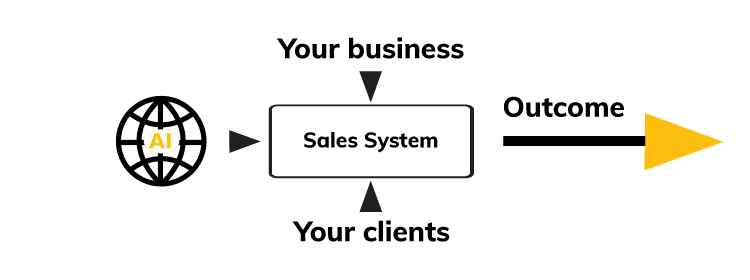
Do you leave your sales results to chance?  Well you might be if you are like most businesses that are too fixated on Sales Results – the Outcomes. Managing by numbers, sales managers can get blinded by measuring the number of sales made and revenue and profit margins achieved rather than focusing on the vital activities that produce these outcomes in the first place– The Sales Inputs.

Every outcome is the result of its inputs.  Every effect has its corresponding cause(s).

Consider the following questions:

  • Do you know how your sales people actually achieved their sales results?
  • Do you know how well they are identifying real opportunities with their prospective clients and current accounts?
  • Do you know how well they are planning and managing their sales portfolio and their time?
  • Do you know how well they are utilizing the CRM to help drive sales and manage relationships?
  • Could there be more opportunity in these accounts that is otherwise being identified by your sales people?
  • How easy is it for a new comer to learn and replicate what your top sales performers do?

These are just some of the questions that if examined for their content, would make the lives of sales managers and sales people that much better.  Sales people would know the vital activities they need to perform and to what standard and what knowledge they need to apply to add real value.  And sales managers would yield much better sales results all round if they devoted more of their time coaching and managing their sales people around these input activities rather than only looking for and reporting on their sales results.

Do you want to increase your sales team’s effectiveness and boost sales results?

Pay attention to the details because excellence is in the details.  Look at what you put in to see what you get out in terms of sales results.

Sales managers, sales people and business leaders could learn a lot from observing the Quality and Quantity of their actions each day.  We call these the Input Measures which are made up of Type & Quantity of Activity and Quality of Activity.   These are the areas that people can be trained and coached in.

Type & Quantity of Activities – the following are examples of types of activities:

  • Leads developed
  • Prospecting calls
  • Client meetings
  • Proposals developed
  • Deals in the pipeline
  • Up / Cross sales discussions
  • Customer inquiries
  • Account management calls / meetings
  • Account reviews had
  • Referrals requested

Quality of Activities – the following are examples of competencies or standards of activities:

  • Business acumen
  • Sales Planning skills
  • Prospecting skills
  • Selling skills
  • Communication skills
  • Relationship building skills
  • Negotiation Skills
  • Product knowledge
  • Company  and market knowledge
  • Problem solving
  • Client proposal development
  • Self-Management

Sales Managers can really make a significant difference to their sales results and the lives of their sales people if they invest the time in coaching, training and working with their people on the Input Measures rather than pointing out the results week in week out.  Results are important and need to be acknowledged but they can only be as good as the inputs. Once we understand the Input Measures then we can see their effect on the Results or Output Measures.

Output Measures / Results can include:

  • Overall Sales made including sales with new clients and existing clients
  • Sales revenue
  • Sales profitability
  • Sales growth
  • Sales quotas
  • Sales by product or region
  • Average deal size
  • Market share & growth

Let’s make sure that sales results are not left to chance; work on the inputs and get them right.  It will make a difference to your results.

Remember everybody lives by selling something.
Author: Sue Barrett, MD of www.barrett.com.au

Like exercise, prospect a little each day and stay sales fit

May 26, 2011 in Call Reluctance, Prospecting, Sales Skills, Sales Training, Self Development, Success, Time Management, Tips

Prospecting is considered one of the most daunting jobs in selling.  Many people in sales or other roles charged with developing new business, especially with new prospects, find the task of prospecting anxiety provoking and tend to put off the prospecting task in favour of more desirable or less frightening tasks.  Yet in their desire to escape prospecting they inadvertently set themselves up for greater issues in the future.

Prospecting is the oxygen that fuels the fire of sales.  Prospecting involves a series of sequential activities designed to:

  • Identify your prospect
  • Qualify your prospect
  • Prioritise your prospect

Prospecting is therefore a step-by-step process for identifying organisations and individuals who have a potential need for your product or service, making contact with them to see if you can be of service and then generating a client & supplier relationship.

Having a plan or system is therefore critical to prospecting success.

Without a prospecting plan you cannot sell because you will not have anyone to sell to.  Prospecting is not the most important aspect of selling, but it’s the first thing that has to happen for the sales process to begin.  Prospecting is not just isolated to cold calling either. It’s essential for reigniting dormant accounts and clients or developing new business with existing clients.

Putting off the task of prospecting will leave your sales pipeline anemic and weak and put your job or business in jeopardy.   In essence, if you don’t prospect you will become ‘sales unfit’.

If we’re serious about our physical health and wellbeing and want to be physically fit we know we need to exercise every day or several times a week in time blocks of 30minutes, one or even two hours. We don’t do little bits then stop.  We do not leave our health to chance and instead set aside time in our day to pay attention to our physical wellbeing.  So why leave our sales result and careers to chance?

Yet too many people charged with growing sales and healthy client relationships leave their sales fitness to chance by not prospecting on a consistent and regular basis.

One reason people find it hard to prospect is because they have never been taught how to prospect effectively.  Prospecting is a skill like everything else and it can be taught.  That is why at Barrett we find ourselves doing a lot of coaching and training in our 4 Step Prospecting Process.  It is one of the most impactful training modules in our training program.  Once people learn to master the skill of prospecting the results are fantastic.  “Just wanted to say a BIG thank you to you for your assistance with one of my clients. I got them back! What helped most was omitting that “fear of rejection” like you said. You were right, I had nothing to lose as we had already lost them. In addition, making phone calls with a clear purpose or intention really assisted with this client, which eventually led to a meeting face to face, and it all went swimmingly. This client is now using us consistently since the meeting, and fingers crossed, this will continue. I am not taking chances this time, and will continue to manage this client carefully. Thanks again for all your help, the follow up phone call with you really made all the difference.” Testimonial from Specialist Recruitment Consultant.

Another important reason why a sales pipeline suffers is because people do not make the time to prospect. This can be because they’re either ineffective at prioritising or they’re afraid of prospecting and so avoid it all together.  Either way avoiding prospecting makes matters worse.

If you have a fear about prospecting even if you have been shown how to prospect, you need to address those fears and then make time to prospect on a regular and consistent basis. Practice at prospecting will also help overcome your fears a bit at a time.  If you have difficulty prioritising what is important then you need to make sure that prospecting is made one of your most important priorities.  By doing a little each day you can achieve your sales goals and reduce your anxiety about prospecting one phone call at a time.

Here are some tips For Scheduling Your Prospecting:

  • Schedule specific time in your week for prospecting.
  • Chunk your prospecting calls in batches – maximum of 120 minutes, ideally 2-3 batches per week.
  • Consider doing your prospecting calls first thing in the morning.  This works on two levels, 1) you get it out of the way first thing in the day and, 2) it is often the best time to call people.
  • Ideally make prospecting calls at the same time of the day, each day of the week.
  • Consider when you are at your best. It’s best to be clear headed, listening accurately, awake and alert (this varies for everyone). You are therefore less likely to have negative or self-defeating thoughts and least likely to take rejection personally.
  • Consider distractions – what time of day are you least likely to be interrupted?

Remember follow-up with persistent daily effort
Choosing your state of mind and your attitude is also critical when prospecting and selling. Successful salespeople know that prospecting doesn’t happen by chance as it requires a consistent and persistent effort.  Successful sales people:

  • Diarise follow up calls
  • Use Sales Pipeline to track activity
  • Keep a number of activities on the go
  • Prioritise
  • Persist

Remember everybody lives by selling something.

Author: Sue Barrett, MD of www.barrett.com.au

Exceptional Prospecting and Social Media

April 7, 2011 in Call Reluctance, Communication, Prospecting, Self Promotion, Social Media, Social Sales, Tips

With social networking sites and the plethora of online data available, 2011 presents us with better quality prospecting and more qualified prospects.  ‘Prospecting and Social Media’ was voted as the Number 4 Sales Trends for 2011. Business networking sites such as LinkedIn and Plaxo, and the emergence of Facebook and Twitter as business destinations, give the discerning business or sales person access to quality data where they can research key contacts with an organisation, as well as business activity. Then, when appropriate, they can use this data to make professional connections.

Smart business leaders and sales people are using social networking sites as tools to engage in better quality prospecting and improve conversion rates rather than just using them to make a list of prospects.  These sites potentially make redundant, the concept of Cold Calling and the fear of prospecting and can help people become exceptional prospectors. So how do you get the best out of Social Networking sites when prospecting? Let’s look at the business phenomenon that is LinkedIn.

LinkedIn

For Business to Business prospecting, LinkedIn is proving to be a rich source of information, contacts,  suppliers, prospects, referrals and clients.  It has exploded in connections and content, and usage has skyrocketed in the last 18 months through its many features helping you get connected to the right people.  It is the largest B2B social media networking group in the world.  For instance my own LinkedIn profile and network currently can connect me with over 5,200,000+ contacts, imagine how we could all harness the power of these connections.  So how do you use LinkedIn to help you prospect more effectively?

Step 1: Develop a sales plan, clear message and profile
Before you set up your LinkedIn profile make sure you have a clear sales plan which identifies who you need to be connecting with i.e. types of clients, suppliers, peers, industry sources and groups. Think about what you want to present by way of image, message and purpose i.e. what do you stand for? What do you do for people?  Look at how you would like to position yourself as a business professional.  Like websites, your LinkedIn profile is your professional resume online; it represents your professional brand.  This is why you need to be clear about who you are, what you do and what you want to communicate to a broad audience.  What you do, what your company does, what you represent, people are likely to make up their mind about you based on what they see and read about you.  Your LinkedIn profile should form part of your sales and marketing strategy.

Step 2: Join LinkedIn
Get your profile up and live. It’s easy and it’s free – go to www.linkedin.com and get started.  There are also various levels you can subscribe to enhance your profile and get you better connected with search features and other options.  These extras come with a monthly fee attached.  Begin by using the free access option and try it out before committing to upgrades.

Step 3: Join LinkedIn Groups
There are many and varied LinkedIn Groups you can join. These groups provide people with forums to discuss and exchange ideas and opinion, as well as keep up to date on the latest trends, ideas, innovations, etc.  It’s also where buyers are increasingly looking to research suppliers before they buy.  They are looking for what others say about you and your products or your industry.  They can compare you with your competitors’ offerings.  In these groups you can listen to what your customers are saying before they even decide to talk to you. Your sales strategy should guide you as to who you should be in contact with.  What types of groups would be useful for you to belong to? For instance if you are a Learning and Development specialist, Engineering sales professional, Environmentalist or Procurement Manager then there are groups focusing in these spaces and many more.  But do not limit yourself to the narrow bandwidth of your own expertise. Often looking outside your comfort zone can give you access to new ideas and contacts as well.  These groups allow you to listen to your community, suppliers, clients and other interested parties. This gives you access to a wide range of people.  See Barrett Consulting Group LinkedIn group as an example.  A word of caution: Do not blatantly self promote or advertise your wares in these groups; it will not go down well.  If you try to blatantly self promote and prospect in these groups you will be shunned and often kicked off the group.

Step 4: Start to connect
The best way to build up your network of contacts is to invite people you know to connect with you.  This way you can begin to build up direct connections who, in turn, can then give you access to people outside of your direct network.  You can often look at your contacts list of connections and you can see who might be good to make contact with.  It’s advised that you don’t contact someone you do not know directly without some form of personal connection or link; instead, you can seek an introduction through one of your direct contacts.  Sending out LinkedIn requests to people at random will not be seen as good business and will be deemed inappropriate or spam by many and may affect your reputation.   It is also wise to be discerning about which connections you accept as well.  Don’t just accept invitations from anyone, make sure you find out why they want to connect with and how you can be of best service to each other.

Step 5: Identify and Research Your Prospects
If you are already connected on LinkedIn and you know what types of people you need to prospect to you can look through your contacts lists to see who is there.  You can also develop a list of names of people who are in your target market via business websites which often have names of key contacts or business news sites and industry magazines which often feature key decision makers.  Your own CRM or client database should have lots of names you need to speak to.  And of course you can buy lists once you are on LinkedIn and begin to research your prospects.  In the upper right hand corner, there is a search box with a pull down menu. Click on that and you’ll see six options (people, jobs, companies, answers, inbox, groups). Click on “people” and enter the prospect’s name. You can see a lot of information about prospects, the groups they belong to, what they are interested in, their experience and knowledge, etc.  You can use a prospect’s background to develop questions that relate to their area of responsibility. It will help you to develop very clear Valid Business Reasons (VBR’s) when calling them.   Make sure you know how to get prospects to talk to you.

Step 6: Start Prospecting
Develop a list of 20 to 40 prospects per week and then make contact via the telephone as you would normally do.  Use relevant VBR’s to help you connect. Pretty soon you will be making contact with the viable prospects and on your way to making more sales.  If you are still not comfortable calling people via the phone you can use Linkedin as a prospecting option however make sure that you still use a VBR  in your message or invitation to them.

Summary
Does this mean you will learn everything about a person via their profile or that you take a carte blanche approach to prospecting? NO. We will need to be mindful about how we go about making contact as we will still need to engage in skillful prospecting activities to position ourselves effectively. Remember information is not POWER it is potential power. LinkedIn and other social media networks are not the only sources for prospecting but they certainly can help you achieve peak performance in prospecting.

With clear sales plans and well defined prospect profiles there’s no excuse NOT to prospect effectively.  2011 will be about a Total Quality Prospecting environment.

Remember everybody lives by selling something.

Author: Sue Barrett, MD of www.barrett.com.au