
In 30 seconds
The Problem Most organisations try to sell before they have earned the right to. They skip straight to outreach, proposals, and pitches – and wonder why buyers are not listening. It is not a quality problem. It is a sequence problem.
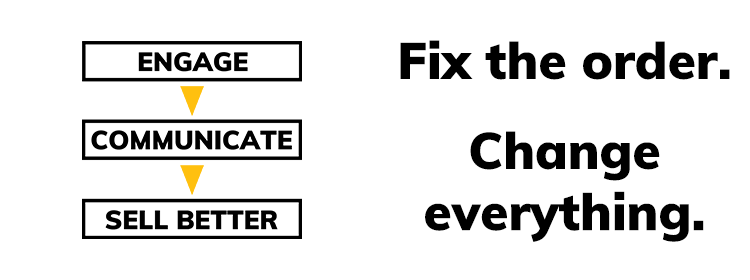
The Shift Engage first. Be visible and useful where buyers research before any conversation begins. Then communicate value – not information, but translation. Convert your capability into the buyer’s specific outcome, language, and risk.
The Solution When you engage and communicate well, selling becomes the natural next step – not a hard ask. Fix the order. Change everything.
In 3 Minutes
Editor’s Note
This is Article 2 in Barrett’s 2026 blog series: Engage, Communicate and Sell Better – a nine-part series exploring why sales, marketing, and digital must now operate as one commercial system, and what that requires of your people, your content, and your culture. Article 1: We Are in the Weeks Where Decades Happen. Article 2: Why the Sequence Matters. This piece. Coming: The Three Disciplines | The Invisible People Gap | The Generational Buying Committee | The Four Questions Buyers Ask Before They Call You | The Double Gap Research | The Commercial System That Closes It. Each article stands alone. Together they build the full argument.
Most organisations try to sell before they have earned the right to. That is why most of what they put into the market – the emails, the LinkedIn posts, the cold calls, the proposals – feels like noise to the buyers on the other end.
It is not a quality problem. In most cases the product is sound, the team is capable, and the intention is genuine. It is a sequence problem. They have the steps in the wrong order.
Engage, communicate, and sell better is not a slogan. It is the operating logic for becoming signal in a world full of noise.
Step One: Engage
Engaging is not broadcasting. It is not scheduling three LinkedIn posts a week or refreshing your website’s homepage image. It is the discipline of being present, visible, and genuinely useful in the places where buyers go when they are thinking about problems you could help them solve – before they are ready to buy, before they have raised their hand, before they know they need you.
What does this look like in practice?
- Your website passes the 20-second test: a buyer lands on it and within twenty seconds understands not only what you do, but what their business achieves by working with you.
- Your people are active in the channels where buyers research – contributing real perspective, not corporate noise.
- Your content answers the questions buyers are actually asking, not the questions you wish they were asking.
Engage is about being found and felt before a conversation begins. It is the work that makes every subsequent interaction warmer, more relevant, and more likely to proceed.
Most organisations skip this kind of engagement entirely. They go straight to outreach. Then they wonder why the response rate is low.
Step Two: Communicate Value
Once a buyer has found you – or agreed to a conversation – the second failure point arrives. Most organisations default to information delivery: features, capabilities, credentials, case studies. They treat communication as the transfer of content from one party to another.
That is not communication. That is a brochure with a pulse.
Real communication in a commercial context is translation. It takes what you know and converts it into what the specific buyer needs to understand – in their language, framed around their risk, articulated in terms of their specific outcome. A property developer needs to know what their residents experience and what their compliance risk looks like. A healthcare operator needs to understand what their precinct achieves and what their maintenance cost does over ten years. A CFO needs to hear margin, risk reduction, and return – not a product walk-through.
Buyers do not need more information. They can find that in seconds online. What they cannot find on their own is someone who translates your capability into their specific situation. That is the communication gap – and it is where most deals are lost before price is ever mentioned.
Step Three: Earn the Right to Sell
When you have engaged well and communicated value clearly, selling is not a hard ask. It is the natural conclusion of a process the buyer has already been part of. But now it provides additional benefits beyond just a product or service they acquire:
- They feel understood.
- They can see what they achieve.
- They trust the people they will be working with.
- The commercial conversation – price, terms, scope – happens in that context, not instead of it.
Compare that to the organisation that skips the first two steps. They call before proximity is built. They present before trust is earned. They quote before the buyer understands what they are buying. Then they face objections on price, on timing, on fit – that are really expressions of uncertainty the organisation created by getting the sequence wrong.
Selling better is not revolving around a closing technique. A deal is the outcome of engaging and communicating better first. The sequence is the system that leads to a close – not some heavy lifting at the very end of the process.
Check Your Own Order
If you are struggling with conversion rates, pipeline velocity, or deals that stall before the finish line, the instinct is usually to improve the pitch, sharpen the proposal, or train the team on objection handling. Sometimes that helps. More often it treats the symptom.
The more useful question is: are you getting the sequence right? Are you engaging before you ask for the meeting – or are you asking for the meeting and hoping engagement follows? Are you conveying value before you send the proposal – or are you sending the proposal and hoping it communicates value on its own? Are you earning the right to sell – or are you just selling and wondering why buyers are not listening?
Fixing the order changes everything. Not because the underlying capability changes, but because buyers experience it completely differently when it arrives in the right sequence.
Next in the series: the three commercial disciplines – business development, digital social selling, and prospecting – that most organisations are running as one, and why that is where the sequence breaks down first.