
In 30 seconds
The Problem Most organisations treat Business Development, Prospecting and Digital Social Selling as the same job, run by the same people, measured the same way. They are not the same. Collapsing three distinct disciplines into one creates a commercial engine that is permanently misfiring.
The Shift BD creates territory. Prospecting earns conversations. Digital Social Selling makes both work by building buyer familiarity before any human contact occurs. Each has a different cadence, a different measure, and a different purpose.
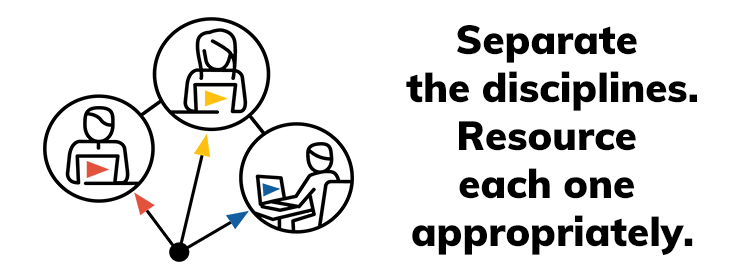
The Solution Separate the disciplines. Resource each one appropriately. Measure each one differently. Then your commercial engine starts working the way it was designed to.
In 3 Minutes
Editor’s Note: This is the third article in our eight-part series built around Barrett’s GYSAT research into 229 ANZ B2B organisations. Each article addresses a distinct failure point in how organisations engage, communicate and sell. Article 2 established why the sequence matters. This article goes inside the engine itself.
Most sales leaders know something is not working. Conversations are harder to start. Conversion is slower. The pipeline looks busy but the wins are thin. The temptation is to push harder on activity – more calls, more emails, more outreach. But activity is not the problem. Architecture is.
The commercial engine most B2B organisations are running has a structural fault built into it. Three distinct disciplines – Business Development, Prospecting, and Digital Social Selling – are being treated as one job, done by the same people, measured by the same metrics, and resourced accordingly. That is why it breaks down.
Business Development creates new territory.
Its job is strategic. New markets, new segments, new channels, new categories of opportunity. BD operates on a long cadence – months, sometimes years. Its measure is opportunity creation, not conversion. You cannot rush it without distorting it.
However, here is what has changed. The old BD toolkit – events, referrals, relationships built over lunches and industry dinners – is now only half the picture. The other half is the thought leadership your organisation puts into the market continuously. Buyers form impressions of organisations long before any human contact occurs. BD without visible digital presence is working on half the territory. Your organisation may be strategically brilliant and commercially invisible at the same time.
Prospecting earns the conversation.
This is direct, intentional contact with named individuals. Its measure is conversion. Its cadence is daily and disciplined. Unlike BD, it is not strategic in the long-range sense – it is precise and personal.
However, the old model of prospecting is under serious pressure. Volume and interruption no longer produce results. Buyers are not answering unknown calls. They are screening. They are researching. And here is the critical shift: a buyer now researches the person calling them before they agree to a meeting. If that person is silent online – no content, no visible perspective, no evidence of understanding the buyer’s world – the call lands cold. Not because the salesperson is performing poorly. Because the buyer had no reason to warm to them before the phone rang.
But how could they warm up to the salesperson before they even call? Creating proximity is what the third discipline is about:
Digital Social Selling makes both of the others work.
This is the discipline most organisations either ignore or misunderstand. It is not a marketing campaign. It is not a content calendar managed by someone in communications. It is the continuous, always-on practice of every commercial person being visibly useful, recognisably human, and commercially relevant in the channels where buyers research.
Its measure is not followers or likes. It is this: when a buyer is researching your sector at eleven o’clock on a Tuesday night before a specification meeting the next morning, do they find a person from your organisation who clearly understands their world? If the answer is no, your prospecting will underperform regardless of how disciplined the activity is.
Digital Social Selling is not optional infrastructure. It is the foundation that BD and Prospecting stand on.
The structural problem.
Most organisations have never separated these three. They expect the same commercial people to do all three simultaneously, with the same tools, the same time allocation, and the same KPIs. BD people are measured on call volume. Prospectors are expected to be thought leaders. Digital presence is treated as a nice-to-have – something marketing handles when there is spare capacity.
The result is a commercial engine where everyone is busy, and nothing is working as well as it should.
The fix is not a new CRM or a bigger team. It is clarity. Separate the disciplines. Define what each one is actually trying to do. Resource each one appropriately. Measure each one differently.
When BD, Prospecting and Digital Social Selling are each doing their distinct job, the commercial engine starts to work the way it was designed to. Buyers find you before you call. Your call lands warm. And the conversation that follows feels like the next logical step – not a cold interruption.
That is the difference between a commercial system and a commercial scramble.
Next: Article 4 – Your Buyers Are Researching You Right Now. What Do They Find?