
In 30 seconds
The Problem: Sales is handed strategy, not invited to shape it. Excluded from executive decisions, frontline teams default to discounting and deference – the very vendor mindset leadership tells them to abandon. You cannot ask your people to earn a seat at the client’s table when they don’t have one at their own.
The Shift: Treat Sales as a strategic function, not a delivery mechanism. The sales leader belongs in the room where product, finance, and marketing decisions are made – as Chief Revenue Architect, not note-taker.
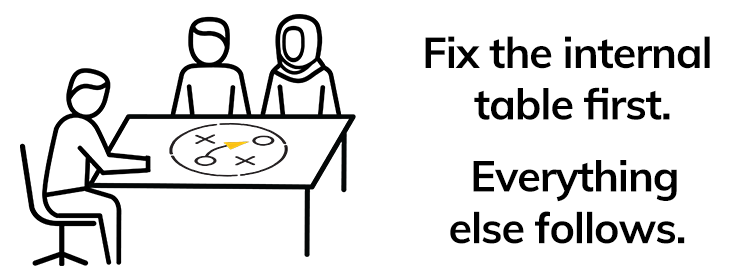
The Solution: Fix the internal table first. Everything else follows
In 3 Minutes
Every day, sales leaders and business owners deliver the same directive to their frontline teams: stop acting like vendors. Get in front of the right people. Elevate the conversation. Earn a seat at the client’s strategic table.
It is a worthy ambition. We want our salespeople trusted as advisors, not tolerated as order-takers. We expect them to navigate complex buying committees, challenge assumptions, and influence long-term decisions. The standard is high, and rightly so.
However, there is a structural hypocrisy sitting at the heart of how most businesses operate – and it undermines everything.
If Sales does not have a seat at your own executive table, you cannot credibly ask your frontline to earn one at the client’s.
The Downstream Problem
In too many organisations, strategy is set in a vacuum. Product teams build what they find interesting. Finance sets the margins. Marketing creates the messaging. Then it all gets handed over the wall to Sales with a single instruction: go hit your number!
When Sales is treated as a delivery mechanism rather than a strategic function, three things happen – and none of them are good.
First, the feedback loop dies. Your salespeople are in the market every single day. They know what clients actually care about, what objections are recurring, and where the real friction lives. When they are excluded from strategic conversations, product development becomes divorced from commercial reality. You end up building features nobody wants to buy.
Second, discounting becomes the default. When Finance sets targets without field input, quotas lose touch with market conditions. To close the gap, salespeople fall back on price reductions – instantly destroying the trusted advisor positioning you told them to build.
Third, and most damaging, the vendor mindset takes root internally. It is very hard for a salesperson to show up as a confident, peer-level advisor to a CEO when their own organisation treats them as a subordinate execution unit. That deference becomes a habit. It follows them into every client meeting.
The vendor mentality does not start with your salespeople. It starts with how leadership treats the sales function.
What One CEO Figured Out in a Single Morning
In 2015, Barrett was engaged by a B2B Agribusiness banking client to conduct a sales systems review. When we run these reviews, we always want the entire C-suite in the room – the MD/CEO, Finance, IT, Marketing, HR, Credit, Operations, and Sales leadership together. That is not always easy to arrange, and it was not easy here either.
But we got the CEO in. What unfolded was revealing.
The Barrett Sales Systems Review is not a sales audit. It is a whole-of-business diagnostic. It surfaces the hidden ways that every function – credit policy, onboarding processes, marketing messaging, operational delivery, finance structures – either enables or actively obstructs the sales effort.
Sitting in that room, the CEO saw it clearly for the first time. He could see exactly how decisions made upstream – without Sales in the conversation – were landing on his frontline as friction, lost deals, and frustrated clients. The interconnectedness was impossible to unsee once it had been mapped.
He stopped the session and said words to the effect of: we need to run this again with the rest of the leadership team.
The fix was not a sales training program. It was a structural one. Sales got a seat at the leadership table. And they never left. This is just one of many similar situations we have experienced over the years.
Building the Internal Table
Fixing this is not complicated, but it does require deliberate structural change.
- Bring Sales upstream. Your Sales Director should be in the room when product roadmaps and go-to-market strategies are being formed – not briefed on the outcome afterwards. They are the voice of the customer’s real friction points. Use them accordingly.
- Align Marketing and Sales at the metric level. If Marketing is rewarded for volume of leads and Sales is rewarded for closed revenue, they are optimising for different outcomes. Unite them under shared commercial metrics so both functions are accountable for the quality of the conversation, not just the quantity.
- Elevate the Sales leader as an equal. The head of your sales organisation should carry the same weight in the boardroom as your CFO or CTO. They are not simply managing the closing team. They are your Chief Revenue Architect – the person translating market intelligence into commercial strategy in real time.
You cannot expect your people to hold their ground with a client, push back on bad requests, and operate as genuine strategic partners if they do not see that behaviour modelled and valued inside their own company first.
The Standard Starts Here
Earning a seat at the table is the defining ambition of human-centred selling. But it has to begin at home.
Examine your own executive table – honestly. Is Sales in the room where strategy is made? Does your leadership team truly understand how their decisions shape – or sabotage – the commercial effort? If not, that is where the work starts – long before your frontline walks into any client meeting.