
In 30 seconds
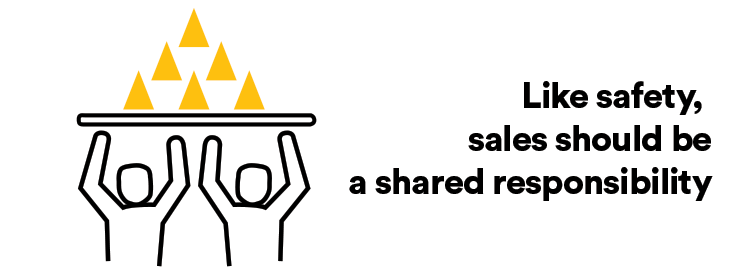
Just like safety, sales should be a shared responsibility across all teams—not just the sales department. When organisations embed a sales culture the way they do safety, every employee understands how to spot opportunities, communicate value, and contribute to growth. Research shows that effective communication training boosts productivity by 25% and companies with strong internal alignment see a 20% performance increase. Additionally, businesses investing in training see up to $33 ROI for every $1 spent. By equipping all employees with critical communication, collaboration, and commercial skills, organisations improve client retention, operational efficiency, and long-term success. Just as safety training prevents costly incidents, sales culture training reduces lost revenue, poor client retention, and inefficiencies.
In 2 minutes
When we think about safety culture in an organisation, we understand that it isn’t just the responsibility of a single team—it’s embedded in every role, at every level. Whether it’s operations, HR, finance, or the frontline workforce, everyone plays a part in maintaining safety. The same principle should apply to sales. Sales is not just a department; it’s an organisational capability.
Why Sales Culture Should Be Embedded Like Safety Culture
In organisations with strong safety cultures, employees are trained to spot risks, take action, and protect the business. Likewise, in businesses with a strong sales culture, everyone understands how to identify client opportunities, communicate value, and engage effectively to contribute to business growth. Sales should be seen as a shared responsibility, much like safety, ensuring the long-term success and resilience of the business.
The Business Case for a Sales Culture Mindset
Just as safety failures result in financial and reputational risks, weak sales cultures lead to missed opportunities, lost revenue, and disengaged customers. Research shows that:
- Effective communication training can increase team productivity by 25% (Forbes)
- Companies that prioritise strong internal communication experience a 20% boost in performance (AI Screen)
- Businesses investing in employee engagement see a 19.3% increase in operating income annually (AI Screen)
- Organisations that train all teams—not just sales—in relationship-building skills achieve higher client retention and repeat business (Harvard Business Review)
- By 2030, two-thirds of all jobs will require advanced soft skills, such as communication, collaboration, and business acumen (McKinsey)
These figures highlight that when communication, collaboration, and commercial acumen are developed across all teams, businesses see a measurable return on investment, much like they do when they invest in safety initiatives.
How Sales Culture Benefits Every Role
A strong sales culture isn’t about pushing products—it’s about fostering an organisation-wide mindset that understands and supports business growth. Here’s how this applies across different functions:
- Operations & Supply Chain → Understanding customer needs lead to smarter resource planning and improved service delivery
- Finance & Legal → Awareness of revenue-generating activities ensures better financial planning, risk management, and contract structuring
- Marketing & Customer Support → Consistent messaging and stronger engagement with clients improve customer experience and brand loyalty
- HR & Leadership → Developing sales culture through training, coaching, and internal collaboration boosts overall company performance
Just as workplace safety training empowers employees to take responsibility for risk prevention, sales culture training empowers employees to drive business success.
The ROI of Investing in a Sales Culture
Many businesses hesitate to invest in broad-based sales and communication training, assuming it’s only relevant for the sales team. However, research proves that companies investing in training and development see tangible returns:
- Effective sales training can deliver high ROI—up to 353% or $4.53 for every $1 spent—by boosting revenue, shortening sales cycles, increasing win rates, and reducing staff turnover, making it a critical investment for sustainable growth (Southern New Hampshire University)
- 31% lower employee turnover in companies with strong training programmes (Wikipedia)
- Customer-centric organisations see a 25% increase in loyalty and repeat business (Bain & Company)
Just like safety culture reduces costs associated with workplace incidents, sales culture reduces costs associated with lost revenue, poor customer service and retention, and inefficiencies in client engagement.
Embedding a Sales Culture in Your Business
The best organisations don’t wait for accidents to improve their safety culture—they proactively train, coach, and reinforce behaviours to create a safe work environment. The same principle applies to sales culture. It requires:
- Training every employee to identify sales opportunities and engage with stakeholders effectively
- Aligning all teams to the go-to-market strategy so they know how they contribute to business growth
- Providing clear, practical communication tools to ensure every client interaction adds value
- Embedding a commercial mindset across all roles, ensuring employees understand their impact on revenue and customer relationships
Ready to Future-Proof Your Organisation?
By treating sales culture with the same level of commitment as safety culture, organisations create a resilient, high-performance environment where everyone understands their role in business success.
Partner with Barrett to equip your teams with the skills they need to thrive. Let’s build a human-centred, high-performance sales culture—together.
Schedule Your Complimentary Consultation Today and unlock your team’s full potential.
I agree that more Sales are achieved when all the team have been trained to identify opportunities. I have some new staff that need training & older staff that need refreshers because sometimes when the business is developing new programs for us to use that becomes the complete focus & looking for sales is thrown out the window!