
In 30 seconds
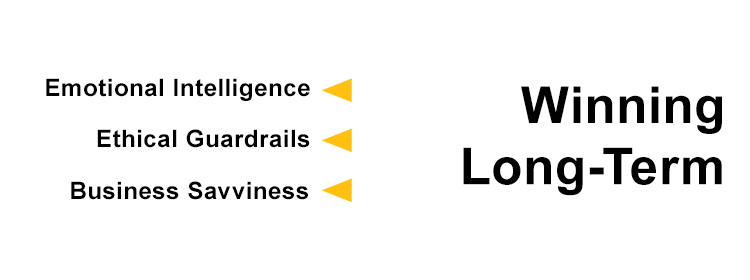
A national building supplies firm won a big account by slashing prices, only to lose it six months later to a pricier, more reliable competitor. In contrast, a tech-security BDM secured a $3M high-margin deal by listening, co-creating solutions, and building trust. Game theory proves cooperation outperforms deception: short-term wins erode trust, long-term partnerships drive success. The 2025 Edelman Trust Barometer shows 75% of people value enduring relationships over quick gains. The winning formula? Emotional intelligence to navigate relationships, ethical guardrails to assess moral engagement, and business savviness to align strategy with long-term goals. In business, the smartest play is also the most human one.
In 3 minutes
The boardroom was tense. A sales representative for a national building supplies firm had just undercut a competitor by offering the lowest price on a major building contract. The room erupted in quiet self-congratulation – they’d “won” the deal.
Six months later, the victory soured. The builder switched to another supplier: one charging more, but offering reliability, after-sales support, and fewer headaches. The discount-driven approach had bled margins, eroded value, and secured nothing in the way of loyalty.
Across town, another kind of deal was unfolding. A Business Development Manager from a tech-security company spent weeks listening to a client’s vision, understanding operational constraints, and co-designing a tailored solution. When the contract closed, it was worth $3 million: a high-margin, relationship-rich, and primed for long-term growth. The client later said, “You understood our needs. You didn’t just sell; you partnered.”
Two deals. Two outcomes.
One glaring truth: in the long game, trust beats short-term wins every time.
The Strategic Imperative of Trust
In the complex landscape of modern business, deception can look tempting – a quick way to get ahead. Withholding information, manipulating terms, or chasing short-term advantage might deliver a momentary high, but it corrodes trust, damages relationships, and ultimately limits growth.
Game theory makes the case clear. In “The Game of Trust,” players can cooperate or cheat. Mutual cooperation leads to shared success. Mutual cheating leaves everyone worse off. Cheat while your counterpart cooperates, and you might score once, but you’ll destroy the foundation for future collaboration.
The 2025 Edelman Trust Barometer quantifies this:
- 75% of respondents believe long-term partnerships are critical for success
- Only 25% prioritise short-term gains
History offers the same warning. During the Cold War, trillions were poured into an arms race with no ultimate victor, just wasted potential. The lesson is universal: deception may offer temporary gains, but trust delivers lasting advantage.
The Cost of Deception vs. the Value of Collaboration
In Australia, these dynamics play out every day.
- Price-first deals: Like the building supplies example, focusing purely on price often ends in a race to the bottom, leaving suppliers vulnerable to being replaced the moment a cheaper offer comes along.
- Partnership-first deals: Like the tech-security contract, investing in understanding a client’s business, co-creating solutions, and aligning with their values can lead to larger contracts, higher margins, and enduring loyalty.
It’s important to remember while some deliberately set out to deceive, many adopt these tactics simply because they haven’t been shown a better way. That’s why exposing leaders, sales teams, and procurement professionals to the principles of game theory, and the art of winning well together, is critical. It’s not about vilifying “cheaters,” but about demonstrating a superior path.
The Professional Tools That Make It Work
Three capabilities make trust-based strategy possible:
- Emotional Intelligence (EQ): The ability to sense tensions, understand perspectives, and guide conversations towards mutual benefit. The Edelman Trust Barometer reveals that 68% of people value leaders who demonstrate empathy and communicate clearly. In high-stakes negotiations, EQ can defuse conflict, open dialogue, and preserve relationships.
- Business Savviness: The knowledge and skill to interpret market signals, identify opportunities, and make decisions that align with long-term goals. Companies that collaborate on sustainable initiatives, like waste reduction or energy efficiency, often unlock new markets and outpace competitors.
- Ethical Decision-Making Frameworks (Bandura + Mirror Engagement): Embed a practical ethics engine that spots and corrects drift in real time:
- Detection lens: Albert Bandura’s 8 mechanisms of moral disengagement (e.g. moral justification, euphemistic labelling, advantageous comparison, displacement/diffusion of responsibility, disregard of consequences, dehumanisation, attribution of blame).
- Engagement lens: the corresponding “mirror” mechanisms that convert each disengagement into an ethical alternative (e.g. ethical grounding, truthful language, absolute accountability, ownership, personal agency, consequential awareness, humanisation, self-reflection).
A Professional Path Forward
The data, the theory, and the stories align: in a world where three-quarters of professionals value long-term partnerships, the choice is not just ethical, it’s strategic.
By equipping teams with ethical decision-making frameworks, emotional intelligence and business savviness, and by committing to collaboration over short-term deception, businesses can build resilience, profitability, and trust that endures.
Game theory gives us the framework. EQ, ethical frameworks, and business acumen give us the tools. Now, it’s on leaders and teams to choose the strategy that wins in the long run.
The future belongs to those who cooperate. The smartest play in business is also the most human one.