
q

You are browsing the archive for Call Reluctance.

8 Top Tips To Stop Yielding and Start Earning

September 22, 2011 in Call Reluctance, Coaching, Prospecting, Sales Assessments, Sales Training, Tips, Yielding

Do you experience difficulties asserting yourself with others in a sales context?  Is maintaining positive relationships with clients so important to you that you are concerned these relationships may be damaged if you are perceived as pushy or intrusive? Do you hesitate to prospect, sell or self promote due to a reflexive fear of being considered too pushy, intrusive, or selfish?

If you recognise any of these behaviours you might just be suffering from the debilitating behavioural issue known as ‘yielding’ which affects many sales people and keeps them from earning what they are worth.

Despite the fact that selling requires assertive behaviour, ‘yielding’ is the most common behavioural issue for sales people. The result of yielding is underperformance in sales and devastating consequences for the individuals concerned, their teams, customers and managers.

So how do you stop yielding and start earning?

Make no bones about it, selling is an assertive profession.

Selling requires people to ‘push’ themselves out into the market place and put themselves in the right position to work with the right customers.

balanced approach

A Balanced Approach

People who act assertively are:

  • Positive – Rather than negative.
  • Calm – They’re at peace with themselves & others.
  • Enthusiastic – They complete tasks with zest & feel they’ll succeed at them.
  • Proud – They accomplish what they do without stealing ideas from others.
  • Honest – When they give their word that they’ll do something, they do it.
  • Direct – They don’t play manipulative games to get what they want.
  • Confident – They take calculated risks.
  • Satisfied – They know where they’re going & how they’re going to get there.
  • Respect for others – They recognise others have needs & rights.
  • Energetic – Their energy is directed toward achieving their goals.

By contrast, yielding is passive, fear-based behaviour and is usually learned* to avoid dealing with difficult or confronting situations.  If practiced too much it can become a deeply ingrained habit affecting many situations in life.   Some of these habits include:

  • indecisiveness, non committal or excessively subjective
  • tend to agree with everything, hesitate to challenge or contradict
  • waiting for the ‘right time’ to prospect or sell
  • needing to be liked over making sales
  • sometimes manipulates others through non-confrontational means such as gossiping, pouting, and passive-aggressive power plays
  • super-sociable, a rapport-builder, empathetic, always agreeing on the surface yet can be critical behind others backs
  • conflict-avoidant; and have difficulty speaking when angry
  • have difficulty closing sales and talking about money
  • focussed on rapport-oriented sales presentations rather than having real discussions about clients’ priorities, issues or needs
  • too quick to accept client objections and let them walk all over you
  • give away margins or discount unnecessarily
  • would rather make friends rather than clients

Sadly sales teams have far too many people with yielding behaviour producing poor sales results. This is endemic in sales and service teams. Individuals with yielding behaviours often show a lack of prospecting capability, poor up-selling and cross-selling skills, have issues with quality control because they will not speak up about issues, often undermine the actions of others, which all leads to the erosion of  trust in relationships which is the very things yielders do not want.  The result is stakeholders and clients not getting what they really need because people with yielding will not ask more in-depth questions, assert themselves or challenge the views of others instead accepting everything on the surface while often disagreeing beneath the surface; and so on.

Often labeling people who act assertively as ‘aggressive’, people with yielding behavior will justify their actions and often resist attempts to be more assertive.   What people with yielding behaviour often do not realise is that when they yield other people feel:

  • Irritated – They wish you’d stand up for yourself  & make your own decisions.
  • Withdrawn – They avoid you because your negative attitude makes it difficult for them to maintain their own positive attitude.
  • Superior – They lose respect for you as a person, because you aren’t willing to stand up for what you believe in.
  • Tired – They waste valuable energy dealing with their negative reactions to you.

Yielding is not cool.  Never has been and never will be.

While building rapport with clients is important, a reluctance to adopt more assertive selling behaviours such as speaking up for yourself, challenging ideas, asking questions, etc. is likely to prevent you from initiating and closing sales.  So how do you overcome your yielding tendencies?

Tips for overcoming yielding:

  1. Remember that the price, terms, conditions, and other related aspects of your product and service have been set with a lot of forethought and planning in mind. Try not to fall for the trap of undermining your own product or service before you begin the negotiation.
  2. Negotiate for positive outcomes i.e. win/win outcomes. Quite frequently giving way, for its own sake only serves to damage the longer-term relationships with your clients and others.
  3. If you give something, ask for something back in return.
  4. People respect assertive people who speak well of their products or service. Inject enthusiasm and real warmth into your discussions. Particularly when you have to say ‘No!’ .
  5. Speak up about how you feel and what you really want – we cannot read your mind.
  6. Don’t make assumptions – always ask questions to uncover what people really need.
  7. Challenge yourself by asking some questions about the situation.
  8. Ask yourself ‘What is the worst thing they can say if I ask for what I want?’ The worst answer is ‘No’, however you will be surprised how often they will say ‘Yes’.

You can assess your sales fitness and behavioural tendencies too, including yielding, by taking the world renowned Sales Preference Questionnaire to give you a more accurate diagnosis.  If you want to know more about your current sales fitness and get your specific development tips and coaching, talk to us at Barrett on (+61) 03 9533 0000.

*Some people have personality traits which are more passive by nature, this means they will exhibit more of these behaviours. However,  they too can learn to be more assertive with training. Most people have learned how to be passive or yielding which means they can unlearn these destructive behaviours.

Remember everybody lives by selling something.

Author: Sue Barrett, MD of www.barrett.com.au

Like exercise, prospect a little each day and stay sales fit

May 26, 2011 in Call Reluctance, Prospecting, Sales Skills, Sales Training, Self Development, Success, Time Management, Tips

Prospecting is considered one of the most daunting jobs in selling.  Many people in sales or other roles charged with developing new business, especially with new prospects, find the task of prospecting anxiety provoking and tend to put off the prospecting task in favour of more desirable or less frightening tasks.  Yet in their desire to escape prospecting they inadvertently set themselves up for greater issues in the future.

Prospecting is the oxygen that fuels the fire of sales.  Prospecting involves a series of sequential activities designed to:

  • Identify your prospect
  • Qualify your prospect
  • Prioritise your prospect

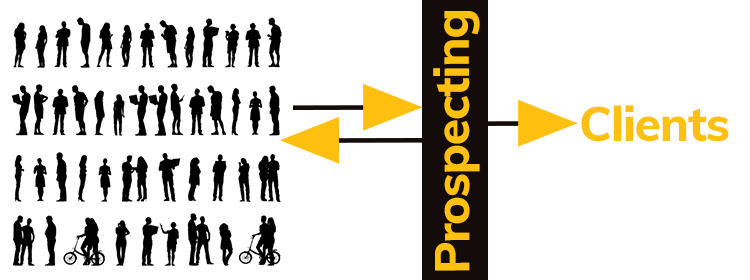
Prospecting is therefore a step-by-step process for identifying organisations and individuals who have a potential need for your product or service, making contact with them to see if you can be of service and then generating a client & supplier relationship.

Having a plan or system is therefore critical to prospecting success.

Without a prospecting plan you cannot sell because you will not have anyone to sell to.  Prospecting is not the most important aspect of selling, but it’s the first thing that has to happen for the sales process to begin.  Prospecting is not just isolated to cold calling either. It’s essential for reigniting dormant accounts and clients or developing new business with existing clients.

Putting off the task of prospecting will leave your sales pipeline anemic and weak and put your job or business in jeopardy.   In essence, if you don’t prospect you will become ‘sales unfit’.

If we’re serious about our physical health and wellbeing and want to be physically fit we know we need to exercise every day or several times a week in time blocks of 30minutes, one or even two hours. We don’t do little bits then stop.  We do not leave our health to chance and instead set aside time in our day to pay attention to our physical wellbeing.  So why leave our sales result and careers to chance?

Yet too many people charged with growing sales and healthy client relationships leave their sales fitness to chance by not prospecting on a consistent and regular basis.

One reason people find it hard to prospect is because they have never been taught how to prospect effectively.  Prospecting is a skill like everything else and it can be taught.  That is why at Barrett we find ourselves doing a lot of coaching and training in our 4 Step Prospecting Process.  It is one of the most impactful training modules in our training program.  Once people learn to master the skill of prospecting the results are fantastic.  “Just wanted to say a BIG thank you to you for your assistance with one of my clients. I got them back! What helped most was omitting that “fear of rejection” like you said. You were right, I had nothing to lose as we had already lost them. In addition, making phone calls with a clear purpose or intention really assisted with this client, which eventually led to a meeting face to face, and it all went swimmingly. This client is now using us consistently since the meeting, and fingers crossed, this will continue. I am not taking chances this time, and will continue to manage this client carefully. Thanks again for all your help, the follow up phone call with you really made all the difference.” Testimonial from Specialist Recruitment Consultant.

Another important reason why a sales pipeline suffers is because people do not make the time to prospect. This can be because they’re either ineffective at prioritising or they’re afraid of prospecting and so avoid it all together.  Either way avoiding prospecting makes matters worse.

If you have a fear about prospecting even if you have been shown how to prospect, you need to address those fears and then make time to prospect on a regular and consistent basis. Practice at prospecting will also help overcome your fears a bit at a time.  If you have difficulty prioritising what is important then you need to make sure that prospecting is made one of your most important priorities.  By doing a little each day you can achieve your sales goals and reduce your anxiety about prospecting one phone call at a time.

Here are some tips For Scheduling Your Prospecting:

  • Schedule specific time in your week for prospecting.
  • Chunk your prospecting calls in batches – maximum of 120 minutes, ideally 2-3 batches per week.
  • Consider doing your prospecting calls first thing in the morning.  This works on two levels, 1) you get it out of the way first thing in the day and, 2) it is often the best time to call people.
  • Ideally make prospecting calls at the same time of the day, each day of the week.
  • Consider when you are at your best. It’s best to be clear headed, listening accurately, awake and alert (this varies for everyone). You are therefore less likely to have negative or self-defeating thoughts and least likely to take rejection personally.
  • Consider distractions – what time of day are you least likely to be interrupted?

Remember follow-up with persistent daily effort
Choosing your state of mind and your attitude is also critical when prospecting and selling. Successful salespeople know that prospecting doesn’t happen by chance as it requires a consistent and persistent effort.  Successful sales people:

  • Diarise follow up calls
  • Use Sales Pipeline to track activity
  • Keep a number of activities on the go
  • Prioritise
  • Persist

Remember everybody lives by selling something.

Author: Sue Barrett, MD of www.barrett.com.au

Exceptional Prospecting and Social Media

April 7, 2011 in Call Reluctance, Communication, Prospecting, Self Promotion, Social Media, Social Sales, Tips

With social networking sites and the plethora of online data available, 2011 presents us with better quality prospecting and more qualified prospects.  ‘Prospecting and Social Media’ was voted as the Number 4 Sales Trends for 2011. Business networking sites such as LinkedIn and Plaxo, and the emergence of Facebook and Twitter as business destinations, give the discerning business or sales person access to quality data where they can research key contacts with an organisation, as well as business activity. Then, when appropriate, they can use this data to make professional connections.

Smart business leaders and sales people are using social networking sites as tools to engage in better quality prospecting and improve conversion rates rather than just using them to make a list of prospects.  These sites potentially make redundant, the concept of Cold Calling and the fear of prospecting and can help people become exceptional prospectors. So how do you get the best out of Social Networking sites when prospecting? Let’s look at the business phenomenon that is LinkedIn.

LinkedIn

For Business to Business prospecting, LinkedIn is proving to be a rich source of information, contacts,  suppliers, prospects, referrals and clients.  It has exploded in connections and content, and usage has skyrocketed in the last 18 months through its many features helping you get connected to the right people.  It is the largest B2B social media networking group in the world.  For instance my own LinkedIn profile and network currently can connect me with over 5,200,000+ contacts, imagine how we could all harness the power of these connections.  So how do you use LinkedIn to help you prospect more effectively?

Step 1: Develop a sales plan, clear message and profile
Before you set up your LinkedIn profile make sure you have a clear sales plan which identifies who you need to be connecting with i.e. types of clients, suppliers, peers, industry sources and groups. Think about what you want to present by way of image, message and purpose i.e. what do you stand for? What do you do for people?  Look at how you would like to position yourself as a business professional.  Like websites, your LinkedIn profile is your professional resume online; it represents your professional brand.  This is why you need to be clear about who you are, what you do and what you want to communicate to a broad audience.  What you do, what your company does, what you represent, people are likely to make up their mind about you based on what they see and read about you.  Your LinkedIn profile should form part of your sales and marketing strategy.

Step 2: Join LinkedIn
Get your profile up and live. It’s easy and it’s free – go to www.linkedin.com and get started.  There are also various levels you can subscribe to enhance your profile and get you better connected with search features and other options.  These extras come with a monthly fee attached.  Begin by using the free access option and try it out before committing to upgrades.

Step 3: Join LinkedIn Groups
There are many and varied LinkedIn Groups you can join. These groups provide people with forums to discuss and exchange ideas and opinion, as well as keep up to date on the latest trends, ideas, innovations, etc.  It’s also where buyers are increasingly looking to research suppliers before they buy.  They are looking for what others say about you and your products or your industry.  They can compare you with your competitors’ offerings.  In these groups you can listen to what your customers are saying before they even decide to talk to you. Your sales strategy should guide you as to who you should be in contact with.  What types of groups would be useful for you to belong to? For instance if you are a Learning and Development specialist, Engineering sales professional, Environmentalist or Procurement Manager then there are groups focusing in these spaces and many more.  But do not limit yourself to the narrow bandwidth of your own expertise. Often looking outside your comfort zone can give you access to new ideas and contacts as well.  These groups allow you to listen to your community, suppliers, clients and other interested parties. This gives you access to a wide range of people.  See Barrett Consulting Group LinkedIn group as an example.  A word of caution: Do not blatantly self promote or advertise your wares in these groups; it will not go down well.  If you try to blatantly self promote and prospect in these groups you will be shunned and often kicked off the group.

Step 4: Start to connect
The best way to build up your network of contacts is to invite people you know to connect with you.  This way you can begin to build up direct connections who, in turn, can then give you access to people outside of your direct network.  You can often look at your contacts list of connections and you can see who might be good to make contact with.  It’s advised that you don’t contact someone you do not know directly without some form of personal connection or link; instead, you can seek an introduction through one of your direct contacts.  Sending out LinkedIn requests to people at random will not be seen as good business and will be deemed inappropriate or spam by many and may affect your reputation.   It is also wise to be discerning about which connections you accept as well.  Don’t just accept invitations from anyone, make sure you find out why they want to connect with and how you can be of best service to each other.

Step 5: Identify and Research Your Prospects
If you are already connected on LinkedIn and you know what types of people you need to prospect to you can look through your contacts lists to see who is there.  You can also develop a list of names of people who are in your target market via business websites which often have names of key contacts or business news sites and industry magazines which often feature key decision makers.  Your own CRM or client database should have lots of names you need to speak to.  And of course you can buy lists once you are on LinkedIn and begin to research your prospects.  In the upper right hand corner, there is a search box with a pull down menu. Click on that and you’ll see six options (people, jobs, companies, answers, inbox, groups). Click on “people” and enter the prospect’s name. You can see a lot of information about prospects, the groups they belong to, what they are interested in, their experience and knowledge, etc.  You can use a prospect’s background to develop questions that relate to their area of responsibility. It will help you to develop very clear Valid Business Reasons (VBR’s) when calling them.   Make sure you know how to get prospects to talk to you.

Step 6: Start Prospecting
Develop a list of 20 to 40 prospects per week and then make contact via the telephone as you would normally do.  Use relevant VBR’s to help you connect. Pretty soon you will be making contact with the viable prospects and on your way to making more sales.  If you are still not comfortable calling people via the phone you can use Linkedin as a prospecting option however make sure that you still use a VBR  in your message or invitation to them.

Summary
Does this mean you will learn everything about a person via their profile or that you take a carte blanche approach to prospecting? NO. We will need to be mindful about how we go about making contact as we will still need to engage in skillful prospecting activities to position ourselves effectively. Remember information is not POWER it is potential power. LinkedIn and other social media networks are not the only sources for prospecting but they certainly can help you achieve peak performance in prospecting.

With clear sales plans and well defined prospect profiles there’s no excuse NOT to prospect effectively.  2011 will be about a Total Quality Prospecting environment.

Remember everybody lives by selling something.

Author: Sue Barrett, MD of www.barrett.com.au

Different sales assessments and how to use them

January 21, 2011 in Attitudes & Behaviours, Call Reluctance, Coaching, Culture, Emotional Intelligence, Ethics & Values, Prospecting, Recruitment, Sales Assessments, Sales Research, Sales Training, Self Development

If you wanted to, you could sit down for at least four weeks and complete 100’s of sales assessments and there would still be more on offer.  This over abundance of sales assessments can be confusing because they are not all the same.  If you do not know what you want to measure it will make looking for an effective sales assessment tool that much harder.  Here are some questions that may help you select your sales assessments with more precision.

  • Why will this person sell? (Motives, Ambition, Goals)
  • Will this person sell? (Attitudes, Mindset, Not Hesitant, Accountable, Energy, Drive)
  • How does this person sell? (Style, Ethics, Behaviours)
  • Can this person sell? (Skill, Knowledge, Mindset)
  • How well can this person sell? (Job match, Values, Perceptive Reasoning, Self Belief, Mastery Mindset)

As stated before, there is no one sales tool that can answer all these questions.  So at risk of offending some test providers and users, as I am bound to leave out some assessments that could have been included in this piece, I thought I would share with you the tools that we and many other businesses have found to be the most useful in helping us predict sales performance especially when it comes to sales recruitment.

Measuring Sales Prospecting Fitness
Research shows that only about 20% of sales people are fully effective when prospecting.  In use for 30+ years, the SPQ*Gold (Sales Preferences Questionnaire) is a well regarded and widely used assessment designed to specifically detect and measure the emotional response to prospecting – Sales Call Reluctance®.  Call Reluctance® is the emotional hesitation to initiate contact with prospective buyers in sufficient numbers to support organisational goals.

40 years of empirical research in prospecting shows the hesitation to initiate first contact with prospective buyers on a consistent daily basis is responsible for the failure of more competent, motivated and capable sales people than any other single factor.  The fear of prospecting can cost an average of 15 new units of business per month per sales person.  Prospecting is not the most important skill in selling but it is the first thing that has to happen before anything else happens.

Assess the Fear of Prospecting
The fear of prospecting, Sales Call Reluctance® and sales hesitation, an individual’s hesitance to prospect and self-promote for new business, can be objectively measured using the SPQ*Gold® questionnaire. The SPQ*Gold® is an attitude and activity based online assessment that identifies how much initiative, energy and drive an individual devotes to proactive sales prospecting and the amount of energy spent on coping with inhibitors such as fear. The SPQ*Gold® is the only tool that measures the prospecting fitness of people in sales, sales management and customer contact careers.  It is best suited for anyone responsible for meeting sales and revenue targets whether you call yourself a sales person or not.

SPQ*Gold helps you answer these 3 business questions:

  1. How much will they produce?
  2. How soon will it happen?
  3. What will it cost you to get that performance out of them?

Applications

  • Administered online via user name and password sourced via an accredited provider.
  • The SPQ*GOLD® can be used for recruitment and development purposes to measure prospecting fitness.  It produces individual selection reports, team summary reports, and development and coaching reports.
  • SPQ*Gold will NOT measure personality, motivators and values, communication styles, emotional intelligence, leadership styles and derailers, or cognitive attributes and abilities (IQ).

Measuring Sales Performance Characteristics and Style
SPI-Q (Sales Performance Insight Questionnaire) is the latest and most comprehensive sales assessment tool in the marketplace.  The Sales Performance Insights Questionnaire (SPI-Q) has been developed in Australia by Performance Insights and focuses on the attributes that are uniquely relevant to sales.  It is the only product in the market that predicts the multi-dimensional characteristics required by today’s sales professionals, and measures the subtle but critical characteristics that differentiate successful sales people.  The questionnaire measures 25 Sales Attributes, clustered into three broad domains:

  1. Compelling Relationships – measures the preferences the individual has when working with clients and developing relationships i.e. Impact, Credibility, Insight, Attentiveness, Initiation, Influence, Social Leverage, Client Engagement and Negotiation.
  2. Perceptive Reasoning – measures how the individual processes information and makes judgments relating to client issues and solutions i.e. Research, Exploration, Agility, Pursues Learning, Creativity, Structure, Quality Orientation, Rational, Specialist and Judgement.
  3. Channelled Energy – measures the motivators and levers which drive the individual to succeed i.e. Authenticity, Resilience, Self Belief, Recovery, Motivation and Sales Drive.

The questionnaire has been designed to be highly pragmatic and user-friendly (requiring minimal training) with standard interpreted report outputs which are adapted based on the individual’s results.   The SPI-Q is a self-report questionnaire and the accuracy of this profile depends on how honest the individual has been when completing the questionnaire as well as their self-awareness.  It reflects their preferred style rather than their ability.  However, research shows that people’s responses to personality questionnaires can act as a good predictor of how they are likely to behave on the job.  There is no one ‘perfect profile’.

Applications

  • Administered online via user name and password sourced via an accredited provider.
  • The SPI-Q can be used for recruitment and development purposes.  It produces individual reports along with accompanying team summary reports, development and coaching reports.
  • SPI-Q will NOT measure values, leadership styles & derailers, cognitive attributes and abilities or prospecting fitness.

These two tools would be my first choice when recruiting sales people.  If you want to measure Culture Fit, Motives and Values, Leadership Style and Derailers, Emotional Intelligence (EQ) or Cognitive Abilities (IQ) then we recommend the following tools, which while they are not sales specific, have been widely used in sales and sales leadership.

Measuring Culture Fit and Values: The Hogan Motives, Values and Preferences Inventory (MVPI) measures ten core values found in most cultures throughout history i.e. Aesthetics, Affiliation, Altruistic, Commerce, Hedonism, Power, Recognition, Science, Security and Tradition.  It is not sales specific, however, it provides vital information to managers about how to coach and manage their sales people in terms of motivators, values and drivers.  The MVPI provides useful data about the kind of work environment the candidate prefers.  Measuring organisational fit is critical to staff retention and cultural engagement.

Measuring Leadership Style and Derailing Behaviours: Most business leaders have coping behaviours they draw on when under pressure.  The Hogan Development Survey (HDS) measures strategies and behaviours leaders have developed over time (even from childhood) to cope with increased levels of pressure whether due to change, high stress, multi-tasking, work saturation, an unhappy environment or being outside of their comfort zone. The HDS is not purpose built for sales leaders however it has a wide body or research on sales leadership with relevant norm groups to refer to.  Research shows that most leaders display at least one coping style.  In measuring extremes of personality then, it is very important to remember that these can have highly positive implications.  There is, however, always a potential downside to extremes because if they are not managed effectively or appropriately they can become problematic.  When business leaders, especially sales leaders, are not managing their interpersonal façade well (perhaps because of stress, pressure, deadlines, etc.) these extremes can emerge unchecked and upset the delicate balance of teamwork and interpersonal relationships.

Measuring Emotional Intelligence (EQ): Emotional Intelligence (EQ) involves a set of skills that define how effectively people perceive, understand, reason with and manage their own and others’ feelings.  These skills are cornerstones to successful selling, as emotions are an inherent part of why people buy and why they do not. The Genos Model of workplace Emotional Intelligence comprises seven specific EI skills critical to successful selling i.e. Emotional Self-Awareness, Emotional Expression, Emotional Awareness of Others, Emotional Reasoning, Emotional Self-Management, Emotional Management of Others and Emotional Self-Control.  Each skill can apply to successful selling.

Measuring Cognitive Attributes and Abilities (IQ): There are no sales specific attributes and abilities assessments that we know of, however, good quality Attributes and Abilities assessments have been around for over 50 years.  They are often referred to as IQ tests.  They are widely available through accredited providers and most organisational psychologists.  They are becoming more applicable because more sales and many leadership roles, especially sophisticated or more complex sales markets, require high level thinking abilities such as:

  • Verbal – verbal fluency, vocabulary and ability to understand and reason using words.
  • Numerical – ability to use and understand numerical concepts, reason using numbers and perceive logical relationships between them.
  • Abstract – the ability to think clearly and make sense of complexity, which is known as educative ability and the ability to store and reproduce information, known as reproductive ability.
  • Critical Thinking – the ability to clarify goals, examine assumptions, discern hidden values, evaluate evidence, accomplish actions and assess conclusions.

We do not use single assessments.  Instead, we combine tools to give us a more complete picture.
Different sales roles in different industries require different attributes for success.  Thus, profiles should be interpreted with reference to a specific role and its requirements.  It is important that the data from any assessment be combined with other sources of information about the individual when making decisions, particularly in selection settings.  Most assessments have a shelf life of 18–24 months and should be treated confidentially.  If there are major changes in an individual’s life or work, this could change some of the attributes in some assessments.  If you wish to use recruitment grade assessments for sales selection, I hope this helps you make a more informed decision.

To order an online assessment today, please call Barrett on 03 9532 7677 or for further information click on this link  www.barrett.com.au/assessments

Remember everybody lives by selling something.

Author: Sue Barrett, www.barrett.com.au

What is the ideal sales assessment tool to use when recruiting sales people? Part 1

January 13, 2011 in Attitudes & Behaviours, Call Reluctance, Recruitment, Sales Assessments

For many years people have been searching for the perfect sales assessment tool.  Why?  Because identifying and retaining high performing sales talent continues to elude many organisations.  It has become even more important with products losing their competitive edge and sales success becoming hinged squarely around the capabilities and performance inputs and outputs of sales people.

I have been using psychometric assessments as part of my work for more than 20 years now.  In my business alone we have assessed more than 70,000 people in sales, sales management and leadership roles using a variety of high quality assessment tools for both selection and development purposes.  The tools we use are designed to measure Cognitive Abilities, Personality (i.e. sales, leadership and everyday styles), Motives & Values, Call Reluctance and Coping & Derailing Behaviours.

We favour well researched, well built, validated assessments constructed by professional psychometricians because, like diagnostic tools used in medicine and other scientific applications, good assessments are calibrated to measure specific aspects of self.  However, like most instruments they are not perfect.  We are always looking at what’s happening in the world of assessments and we can report that there are thousands of assessments promising all sorts of things.  However, we find that many of them are junk and nothing better than a Cleo quiz which adds nothing to your selection process.

All this research has also revealed that the perfect sales assessment tool does not exist.  Trying to measure all the things we want to know about sales people and leaders with one assessment is unrealistic and virtually impossible.  However, what we do know is that the latest research into modern sales assessments is showing subtle difference between:

  • Influence and Negotiation
  • Impact and Credibility
  • Initiation and Social Leverage
  • Resilience and Self Belief

We are now seeing more purpose built sales assessment tools that are designed to measures key qualities such as:

  • Creating Compelling Relationships – measuring the preferences the individual has when working with clients and developing relationships
  • Perceptive Reasoning  – measuring how the individual processes information and makes judgments relating to client issues and solutions
  • Channelled Energy – measuring the motivators and levers which drive the individual to succeed
  • Contact Initiation – measuring the emotional response to prospecting and the amount of initiative, energy and drive devoted to proactive prospecting as well as the amount of energy spent in coping with inhibiting influences such as fear

Effectively predicting sales success is critical to any business’ success and using well designed, rigorous psychometric assessments as part of a sales selection process can really boost our chances of finding and retaining the right sales people for our business.  However, many people look to psychometric assessments as the panacea, the quick fix, the one source of information that will give them the answer to the question ‘How can I tell if this person will sell and make me lots of money?’  This too is a mistake.

Therefore, to get the most value out of psychometric assessments when applied to your sales selection process you might like to consider these important points:

1.    Use as part of a selection process: Psychometric assessments should be used in concert with other validated selection tools such as structured behavioural interviews, competency based simulation exercises and structured reference checks where findings can be cross referenced against core criteria that have been established as relevant to the job and culture in question.

2.    Predictive Ability: Psychometric assessments should account for no more than 20% of your decision making criteria.  They can never be 100% predictive of performance and if anyone claims an assessment, by itself, can have predictive ability over 60% they are not being truthful.  Sadly, many people rely on overly simplistic grid type assessments that are not predictive of sales success nor purpose built for sales recruitment and are even less reliable than ‘gut’ feel.

3.    Purpose Built: Use recruitment grade psychometric assessments that have been purpose built to measure specific qualities, abilities or attributes.  Quality assessment tools will present information and inform you of the following:

a.    Relevant: Make sure the assessment(s) is designed for use in selection for a ‘normal’ (rather than clinical) population, is calibrated to the appropriate level (e.g. management, supervisory, entry level) and has occupational context i.e. sales.
b.    Practical: Make sure the test/questionnaire is easy to administer, undertake and score.  Check what facilities and equipment are required to complete the assessment and how quickly reports can be generated.
c.    Technical quality: Technical information is typically presented in a test manual and hence, the absence of a test manual should raise some doubts.  In terms of technical properties, you need to consider: Reliability, Validity and Norm groups (these are common technical terms used in psychometrics).  All genuine assessments will provide this data. Wading through statistical information can be dry and confusing for some people.  If that includes you, seek the assistance of a Psychologist or other person familiar with the correct use of psychometrics.  If you decide to ignore technical evidence, because it all seems too hard, it could be at your peril.

4.    What to measure: You are unlikely to get all the information you need from one assessment.  There are a variety of assessments you can use in isolation or in combination and you need to select the ones that will determine what you need to measure for your role.  For example:
a.    Cognitive Abilities – verbal and numerical reasoning, conceptual reasoning, critical thinking, mechanical reasoning, etc.
b.    Personality – everyday preferences, personal and learning styles, self management, team orientation, ambition, etc.
c.    Motives & Values – what makes people happy at work, what drives them, what makes them unhappy.
d.    Coping & Derailing Behaviours – learned behaviours and attitudes that can adversely affect sales and leadership performance when under pressure or operating from a fear or frustration.

5.    Cost: cost will inevitably be a consideration.  In an ideal world you would test everyone with every relevant assessment, however that is not realistic for most businesses.  If you have simple screening tools which you use in conjunction with resume and telephone screening this can be useful as long as they are measuring the right things for your role and business.  However, these simple tools, while cheap, are not usually robust enough to give you the real detail you need to make informed decisions.  Most businesses reserve the more stringent psychometric assessment process until after they have developed a short list of candidates who have been through the initial screening parameters and a thorough Behavioural Interview.  By doing it this way you can manage your costs well.  A number of our clients use assessments as a mandatory part of their selection processes and incorporate this information across all the findings.  This saves them time and money in the long run.  So, balance the cost of including psychometric tools in your recruitment process against the cost of one or more poor selection decisions.  Which bill would you rather pay?

Getting it right when it comes to hiring your sales team is critical. A successful sales person will not only enable your organisation to ride out the economic uncertainty but will ensure you are ready to seize the opportunities that present during the recovery.  As your sales teams are the primary interface between your organisation and your clients, it’s only when you get that interface right that you will achieve true competitive advantage.  Using a robust psychometric assessment process as part of your selection strategy can really assist you.  Next week we will discuss the different types of sales assessments available to you, and show you how and when you should use them.

Remember everybody lives by selling something.

Author: Sue Barrett, www.barrett.com.au